Showing posts with label Religion. Show all posts

"It's not religion, it's human (nature)"

"It's not religion, it's human (nature)."

That is a very common response when religion is accused of having a hand in evil. It might seem reasonable to most people uncritically looking at the discussion.

Well, it is not. The response basically asserts that religion is just a tool and humanity can do good and evil with it (like scientific knowledge). But that is simply untrue.

Religion is not "here's the name of god, do with it what you wish"; it is "here's a ambiguous book vested with the name of god, do whatever you interpret it says." It is not just a tool, it is a catalyst to do anything motivated with a divine authority.

Yes, humanity has good and bad. A evil man could use religion to do evil. BUT, as just explained, religion also allows good people to do evil in the name of god with good intents. And THAT is why religion is criticized of having a hand in doing evil.

Look at the cases of religiously motivated displays of misogyny, homophobia and ignorance in general. Those aren't evil people. Those are people being religious -- just people trying to do good after religion has crippled their reason and morality.

"With or without religion, you would have good people doing good things and evil people doing evil things. But for good people to do evil things, that takes religion." -- Steven Weinberg

Religious Non-harmony

Okay. I mentioned it before: I don't actually think that harmony between religions is ever possible. Unless religions somehow stay completely outside social interactions, harmony will break soon or later.

Religions make assertions about the world. Different religions make contradictory assertions. These assertions inform the beliefs which in turn inform actions. Actions have consequences -- and in the case of actions based on opposing beliefs, the consequence is frequently conflict.

That's a simplified way of explaining why religious harmony is ultimately not possible unless all religions agree (in which case there is only one religion) or one religion takes over the world by brute force and silences all dissenting opinion. The third option is for everyone to recognize that all religions are false and skip requiring "religious harmony" altogether.

And now onto a little viewpoint published in the Straits Times (ST Forum online):

Religion
'Learn to have an open, mature discussion without getting worked up.'

MR MICHAEL ANG: 'To strengthen racial harmony, Christian evangelists need a less intrusive method of spreading their message, while Singaporeans should learn to have an open, mature discussion of major religious differences without getting all worked up ('Christian group says sorry for remarks'; last Friday). Religious harmony can be better solidified, not through finding similarities among the major religions in Singapore but through understanding one another's deep doctrinal differences. As much as non-Christians should refrain from branding every form of Christian evangelism as undesirable proselytising, Christians should spread Christ's message without pestering non-believers to follow the religion. Such an evangelistic approach would, hopefully, help to reduce any disruption to Singapore's religious harmony.'

I can see how people may think that is fine and dandy. Sounds pleasant, doesn't it? A call for more or better religious harmony. So nice and sensible.

I actually think it's rather vacuous. Sorta missing the point a little as well.

Let's take a look line by line.

To strengthen racial harmony, Christian evangelists need a less intrusive method of spreading their message,

"Don't be a dick when spreading the word of god"; Sounds reasonable.

Might work with non-believers who believe in debate and discussion and would peacefully discuss about the evidence that bears on the question of whether your religion is true.

What about a religious believer who believes in his own religion being the one true religion, that non-believers are damned to hell and should ideally be killed if they so dare spread lies (false religions)?

Those are extreme of course. But what about those in between? Some may think it's okay but others might think it's plain offensive. Again, "harmony" is likely shattered.

while Singaporeans should learn to have an open, mature discussion of major religious differences without getting all worked up.

This, I thought, downplayed what transpired. Perhaps there were some folks who got worked up because some Christians were proselytizing against Buddhists, but there are other opinions. I'm of the opinion that asserting that non-believers of your religion can't possibly be happy (expressed in the poster) is plain bigotry.

I don't care what religion or non-religion you belong to. If that's your position then you're an asshole. Even atheists don't claim religious people can't be happy because they're religious. Barring perhaps brain/emotion experts, who the fuck are you to say that?

Religious harmony can be better solidified, not through finding similarities among the major religions in Singapore but through understanding one another's deep doctrinal differences.

I'm not too sure what's this supposed to mean. Understanding differences? Probably. But you probably won't be religious as well then.

I submit that if one were to actually understand what and how differences between religious doctrines come about, one would deconvert and be an atheist. I doubt anyone who studies comparative religion would still proselytize for a single religion with evangelistic fervor.

As much as non-Christians should refrain from branding every form of Christian evangelism as undesirable proselytising, 

Again, it's not the method that drew the attention, it's the message. Bigoted beliefs are undesirable regardless of the method used to spread.

Christians should spread Christ's message without pestering non-believers to follow the religion. Such an evangelistic approach would, hopefully, help to reduce any disruption to Singapore's religious harmony.

Yea, sure. I'd like to see how that happens without evidence on any religion's side.

Until the majority of Singaporeans realize that there is and never was any evidence for any religion and therefore abandon their vacuous beliefs, I find it difficult to envision "religious harmony" with all the religions running around thinking that they have the truth.

NUS Crusaders' Not-pology

Just a day after a photo of its poster spread virally over the social networks, the NUS Campus Crusade for Christ took the posters down and issued an apology. The Straits Times online article reports:

A Christian student group at the National University of Singapore (NUS) apologised on Thursday for making insensitive remarks about Buddhists and Muslims.

The NUS Campus Crusade for Christ, made up of 80 to 100 students, posted an apology on its Facebook page for remarks made on its website and on posters it put up on campus benches on Wednesday.

The university also apologised on Thursday. The Ministry of Home Affairs, which is looking into the incident, said that while people are free to propagate their religion, it should not be done by insulting or denigrating other religions.

The Christian group's posters promoting a mission trip to Thailand said that the country, known as The Land of Smiles, was actually 'a place of little true joy'.

The NUS Campus Crusade for Christ has the following apology on their Facebook wall:

Dear Netizens,

We humbly apologize for the distress we have caused you through the poster of ours that has gone viral online. We recognize that our choice of words used should have been more sensitive and tactful. We acknowledge that everyone is entitled to their own beliefs and it is definitely not our intention to force anyone to believe in what we do.

We have since removed our posters and websites, and will be watchful of future actions. Thank you for your understanding and our deepest apologies again for the distress that this incident has caused you.

With sincere apologies,
On behalf of NUS Campus Crusade

What's the poster that caused this explosion of attention on intolerant/bigoted ideas? You can check it out here at YawningBread where there is too an article on this incident.

Now back to the apology. Notice the statement "We recognize that our choice of words used should have been more sensitive and tactful."? There is not an apology for the bigoted idea expressed in the poster. Rather it's apologizing for the tactless way in which it was phrased. Sweet, huh?

Yet, I would consider it typical or, at least, logical that a Christian would endorse the poster. After all, if you sincerely believe that your religion is the ONE TRUE religion and that you can only experience TRUE happiness by following that religion, then that IS what you would say to non-believers of your religion. To  do otherwise would be being inconsistent.

But the thing is, it is a bigoted idea. So there you have all the other religionists jumping in to say that that is intolerant, insensitive or plain wrong. Liberal Christians jump in to say essentially "that's not what our religion is about".

Some people stated that freedom of religion allows for such offensive speech. Others say that religion or not, bigoted ideas are a no-no.

So how does this resolve in Singapore? Combine the two. You have the freedom to have those beliefs but you cannot express them (lest you cause a fracking riot or something).

That is why I have said before: Religious harmony in Singapore is not religions running happily through the green meadows but an uneasy roundtable where a wrong move by any one religion triggers a free for all; "Harmony" is a euphemism for begrudging tolerance here.

The former is what I suspect most people want (but I contend is impossible) but the latter is what Singapore produces. And that is unhealthy for our society -- we're simply waiting for disaster.

Atheism versus God: How did the universe begin?

You sir are dead wrong about almost everything in the article.

I am referring to this article: Atheism versus God: How did the universe begin? written by Vasko Kohlmayer in the Washington Times Communities. See the article if you wish to read the parts I truncated to maintain length.

There are those who claim that to believe in God is not only unscientific, but also absurd.

This is certainly not the case. To the contrary, it is the denial of God's existence that contradicts both science and common sense.

I'll grant you that common sense might indicate a god. But mind you, our intuitions about the actual mechanisms of the natural world has failed us many times. In fact, many scientific truths are counter-intuitive.

So, what about science? No. As far as scientific evidence is concerned, there is not a SINGLE verifiable piece of evidence indicating the existence of a deity.

The prevailing scientific consensus today is that the universe began with the Big Bang.

[Truncated -- some background on Big Bang theory]
The Big Bang theory describes the initial event as a great explosion which brought forth all the energy and matter in the universe. On this theory, the Big Bang was the beginning of all things. Prior to it, there was nothing: There were no particles, there was no matter. There was not even space or time.

Just a note: The Big Bang theory does NOT claim that there was nothing in the beginning. Please see this previous post: Something from Nothing?

Unlike some creationist retards who make the retarded claim that atheists believe "something came from nothing", that is not the author's beef. So let's move on.

Most of those who don't believe in God say that the Big Bang was a chance event. In other words, the great explosion that brought the universe into being was a cosmic fluke.

But this is an unsupportable position to take, because things just don't happen like that. Explosions – big or small – do not come about without someone or something causing them.

Here's his main beef: atheists believe that the universe/Big Bang is uncaused.

And he goes on to illustrate it,

To illustrate, consider this.

[Truncated -- the analogy]

And yet many atheists make precisely this kind of claim. They say that the greatest of all explosions just happened. On this view, the universe just popped into existence spontaneously.

But does this make sense?

Firstly, explosions, as described, have known causes and we understand the mechanisms -- unlike the Big Bang.

But more importantly, no atheist claim that the Big Bang is therefore necessarily uncaused. In fact, the atheists that I've heard of thinks that the Big Bang has a cause --- they simply don't think invoking a deity explains anything.

Common sense and experience tell us that the world does not work like this.

[Truncated -- lots of drama about a claim atheists do not make]

The problem is, however, that in all of its history science has never observed or documented a single uncaused event.

The atheistic position concerning the beginning of the universe thus goes not only against common sense and our everyday experience, but also against the axioms and observations of science.

In light of this, it is the atheist's position that has an air of absurdness about it.

Yes, the caricature of our position is very absurd. That, I don't disagree.

The huge irony here is that a majority of theists would claim that their god is an uncaused cause. So the absurdity that the author claims atheists believe sits squarely in his own court. All the drama about the absurdity of believing that something is uncaused applies to their god.

Yet, without a hint of irony, he goes on to say

It is only reasonable and logical to assume that the universe – just like everything else – had to have a cause. Judging by the staggering vastness, complexity and beauty of the universe, the cause that brought it forth must have been immensely powerful, superbly wise and exquisitely imaginative.

Such characteristics are normally associated with an entity we term God.

This reeks of stupid: "It's SO PRETTY! ...therefore, goddidit!"

To believe in God – the transcendent cause of the universe – is thus neither illogical nor absurd. Not to believe in him is both.

Unbelief will remain to be logically and scientifically untenable until it can be demonstrated that it is possible for an uncaused event to occur.

On the contrary, unbelief is the ONLY scientifically tenable position until evidence demonstrates the existence of a deity.

To believe that the existence of a god is justified by science is both illogical and absurd.

"Well, it's not all bad!"

 "Why do you atheists always talk about bad things that come from religion? Why don't you ever talk about the good works like feeding the poor and building hospitals, etc?"
"Well, religion is not all bad! Look at all the good things that come from religion like charity and love and etc..."

This one type of defense of religion that I find not only weak but, frankly misses the point.

Firstly, it is basically arguing for the usefulness of religion not for its truth which seems odd when we're arguing about whether a god really exist. But we'll leave that aside since this post is coming from another angle.

"Religion does good too!" sounds almost reasonable, ie not reasonable.

You mean aside from stifling science and education, obstructing justice, denying LGBT rights and perpetuating a general contempt of humanity among other historical atrocities, religions also does charity and some good works? Wow, who knew? /sarcasm.

Put it this way: Say there's a rich guy who love his wife and kids. He is rich and successful businessman who provides welfare for his workers and donates to large sums of money to charity monthly. Every fortnight, he kills a family and rape the kids. But look at all the good things he does!

No. He's a psychopath and needs to be locked up. Same with religion.

What makes the defense even more worthless is the fact that ALL the good works religion does can be and (hopefully) will be done, if not superseded, by secular means. That means we can have all the good without the bad -- religion can and should go.

Discarding theology

Why do atheists typically ignore "sophisticated" modern theology? Simple. The answer is embodied by the Courtier's Reply made by PZ Myers in response to critics of Richard Dawkins' The God Delusion:

I have considered the impudent accusations of Mr Dawkins with exasperation at his lack of serious scholarship. He has apparently not read the detailed discourses of Count Roderigo of Seville on the exquisite and exotic leathers of the Emperor's boots, nor does he give a moment's consideration to Bellini's masterwork, On the Luminescence of the Emperor's Feathered Hat. We have entire schools dedicated to writing learned treatises on the beauty of the Emperor's raiment, and every major newspaper runs a section dedicated to imperial fashion; Dawkins cavalierly dismisses them all. He even laughs at the highly popular and most persuasive arguments of his fellow countryman, Lord D. T. Mawkscribbler, who famously pointed out that the Emperor would not wear common cotton, nor uncomfortable polyester, but must, I say must, wear undergarments of the finest silk. Dawkins arrogantly ignores all these deep philosophical ponderings to crudely accuse the Emperor of nudity.

Simply put, theology is not based on reality.

The Scientific Method is applicable to ANY area of knowledge of reality. What we typically call Science is the different branches of physics, chemistry and biology. But the method is also applied to other areas of knowledge including history and linguistics.

In fact, you use a less rigorous form of the method in your life. When your computer power off suddenly, you hypothesize that there is a blackout or that some hardware in the computer fried. You notice that other electrical appliances in your home is still powered thus ruling out the hypothesis of a blackout and you go on checking other things, so on and so forth.

Theology is basically the study of god. But the thing is, theology does not provide evidence of god's existence. It sometimes tries to prove god through pure logic (ie, armchair philosophy) if not ignoring the issue completely and jumps straight into sophistry about god presuming its existence.

I'm sorry. How is that not nonsense?

Theology is like Germ theory where viruses and bacteria don't exist. Theology is like Paleontology where bones never fossilize. Theology is like Chemistry in a universe where only hydrogen exist forever unchanged.

Dismissing claims for which there is no evidence for is not a "science". It's basic skepticism.

The same point is previously discussed in: Justifications and Beliefs

Do realize that atheists (at least those who have been called "New Atheists") are skeptics first, atheist in conclusion. We are not hostile to religion because of some Atheist doctrine. We are atheists because we were first skeptical of religious claims.

Good is Secular Humanist

This is about a particular type of claim made against Secular Humanism (hereafter referred to as Humanism) and it takes on several forms.

One common claim launched against Secular Humanism (usually as a defense of religion) is that Humanism "is Christianity without God" or "adopted Christian values". This claim accuses Humanism of having values and morals only because it adopted them from Christianity and that it has no grounds for its moral framework.

Another claim attacks Humanism on similar grounds, asking rhetorically, in effect: "Why Humanists say that their way is the rational/moral/correct way?" to accuse Humanists of acting just like dogmatic/fundamentalist religious people.

Going along similar lines, if Humanism is another religion, it extends to the idea that Humanists are breaching the wall between church and state when the government acts in agreement with Humanist values.


Religion or not?
Let's deal with the latter two claims first. Is Humanism a religion?

Yes and No. It depends what you are talking about.

Legally, Humanism should recognized as a religion as a practical category that it fits into. Humanism is a philosophy that are not a religion but play a similar role in a person's life. With regards to the law and rights, there isn't much of a difference between a life philosophy that includes a god (a religion) and one that doesn't have gods. Non-believers should not be denied the same rights religious people have.

Generally speaking however, there's a huge difference between a philosophy, like Humanism, and a religion. Religions have a supernatural or dogmatic aspect -- this makes it fundamentally different from Humanism. In religions, god(s) are supernatural entities and in each religion there are certain beliefs that must be held (dogmatism). Humanism have neither -- in fact, Humanism rejects both on the grounds of skepticism.

So, legally, yes, Humanism is a religion. But aside from that, no, Humanism is not a religion unless you wish to destroy the distinction between philosophies and religion by rendering the word "religion" meaningless.


Getting it backwards
Humanism is not a religion without morals (and thus having to import "Christian values") -- it has morals without religion.

Humanism is a philosophy that stems from rational thought, empirical understanding and driven by human empathy. It values skepticism and the scientific method as tools for improving our understanding of the world. Morals is born of the marriage of reason and empathy.

For some religious people, it may be difficult to understand how morals can be of reason and empathy. Especially those who, unfortunately, believes that morals must be handed down by their god.

But think about it a little more deeply.

Do you do charity,
-- because your contributions can help alleviate another person's suffering,
-- because it feels good to help people,
-- because you need the extra cash/time less than less fortunate people, or
-- because god instructed/liked it?

Do you not commit murder,
-- because you are robbing someone of their right to life
-- because you simply do not have such a desire
-- because you are potentially harming the people who love that person
-- because god said so?

In both cases, only the last option is the truly religious -- the only one that can be regarded as having "Christian" (or whatever religion) value. The first 3 can easily be reached via reason and empathy. They are of human value.


No god required
People operate using reason and evidence to deal with everyday issues. When you get the change from the cashier, you count if you want to know if you were given the right change, you don't pray to find out whether it's really 35 cents. When your television is not working right, you check the manual or the internet to see what could be wrong, you don't go to your holy book for advice.

But somehow, some religious people think that: when they want to know how the world came to be, they read their creation myth instead of gathering evidence from the world to ascertain what they can know about the subject. When they want to know what are morals, they adhere to "wisdom" from an old book written by ignorant men who thought they knew god instead of evaluating the moral issue rationally.

Humanism did not adopt any religious value. On the contrary, religions co-opt human values.

Notice that I said human values as opposed to humanist values. Because it is simply an unfortunate situation that we have to identify ourselves as humanists. Humanists are what humans should be unless they are corrupted by religious dogma and fantastical thinking.

Some religious people like to characterize Humanism as their religion without their god like a beautiful flowering plant without its flower. But the truth is their religion is humanism corrupted by god(s) and other magical thinking -- akin to a beautiful garden which became overrun by the supernatural, dogmatic weeds.

Put another way: "Good religion" is "bad religion" stripped of obvious immoral nonsense. Secular Humanism is just "good religion" stripped of ALL nonsense.

Open, tolerant and respectful

I am guessing that most Singaporeans should have noticed that when it comes to racial or religious harmony, our government always reiterates the same points with the same rhetoric all the time. Don't get me wrong; I do agree that we should maintain racial/religious harmony -- that's not the issue here.

What gets on my nerves is how vague they are every single time that I've seen it. It's always the same vague language, imploring that we should be open, tolerant and respectful of other beliefs. Okay, good. What does that mean?

What is being open?

To be open is to be ready to entertain new ideas. And here in Singapore, I never really thought that this was an issue at all (so far).

What about being tolerant?

To be tolerant something is to permit and endure its existence. Again, I, for one, have no issue with this. I am not, and I hope nobody else is, going to prohibit religion or irreligion in general.

Then what about being respectful?

To show deference to a right. Sure, people have the right to have or not have religious beliefs -- that's fine.

What then is the issue here?

Wait, there's another commonly used meaning for respect I'm forgetting -- to hold in esteem or honor. That? HELL, NO.

Now, think of the common thread that holds this 3 terms together. For non-believers on the internet, I'm pretty sure you might have guessed it -- Criticism of religious doctrines and practices.

In the eyes of (some of) the religious and squishy liberals, simply criticizing religious doctrines and practices is equated to being close-minded, intolerant and disrespectful. Guess what? They're wrong. One can be open, tolerant and respectful of religious beliefs without silencing all opposing ideas (ie, criticism).

I will entertain your beliefs, respect your right to hold them, tolerate your practices AND tell you what I find disagreeable. But the last part is what seems to get their goat. And that appears to me, what they wish to achieve with the usual rhetoric.

When tensions between religions (and the irreligious) mount around the globe, the rhetoric is used to quell any tension that might be building here in Singapore. In this case, it might have been the tension between the freethought community and the religious in the USA and Europe.

It becomes ironic when you consider what happens when religious conflicts do escalate. It ends with one religious faction making a hell of a fuss by rioting. So essentially, I cannot criticize you because you might lose your sanity and kill people -- and this is supposed to be acceptable?

For example, if a riot broke out because a group of people were unhappy with the government's decision, those people are insurgents. But if a riot broke up because a group of people were unhappy because they were presented facts about their religion, those people are good citizens who should be protected from information? Bite me.

I genuinely hope the that is not the position the government is holding and is possibly using that same old rhetoric about religious harmony for more benign reasons.

To summarize, my position is that, I will defend your right to believe in nonsense so long as you do not deny my right to call it nonsense.

Atheism is NOT a religion

The following is a point by point response to the blog article, Has Atheism Become a Religion? by David Lose on The Huffington Post.

Has Atheism Become a Religion?

Before you dismiss the question out of hand, consider these four inter-related bits of evidence:

Actually, I don't have to dismiss this "out of hand". I'll say, right there, you have already gotten it wrong by definition. But let's hear what else you have to say.

1) As recently reported in the New York Times, military personnel who identify themselves as "Atheists" have requested chaplains to tend to their spiritual needs. As the Times article notes, "Defense Department statistics show that about 9,400 of the nation's 1.4 million active-duty military personnel identify themselves as atheists or agnostics, making them a larger subpopulation than Jews, Muslims, Hindus or Buddhists in the military." Having their own chaplains, the article explains, would give Atheists a sense of legitimacy and help validate their own system of values and beliefs.

This bullshit is easy to spot since he actually provides the link to the report he cites. Here's a telling paragraph from the report:

“Humanism fills the same role for atheists that Christianity does for Christians and Judaism does for Jews,” Mr. Torpy said in an interview. “It answers questions of ultimate concern; it directs our values.”

If you can't tell the distinction between atheism, Secular Humanism and religion, perhaps you could, I don't know, try looking up Wikipedia at least?

Atheism is simply the lack of the belief in god(s).

Secular Humanism is,

According to Wikipedia,
Secular Humanism, alternatively known as Humanism (often with a capital H to distinguish it from other forms of humanism), is a secular philosophy that espouses human reason, ethics, and justice, and the search for human fulfillment. It specifically rejects religious dogma, supernaturalism, pseudoscience or superstition as the basis of morality and decision-making.

Secular Humanism is a comprehensive life stance that focuses on the way human beings can lead happy and functional lives. Though it posits that human beings are capable of being ethical and moral without religion or God, it neither assumes humans to be inherently or innately good, nor presents humans as "above nature" or superior to it. Rather, the Humanist life stance emphasizes the unique responsibility facing humanity and the ethical consequences of human decisions. Fundamental to the concept of Secular Humanism is the strongly held belief that ideology — be it religious or political — must be thoroughly examined by each individual and not simply accepted or rejected on faith. Along with this belief, an essential part of Secular Humanism is a continually adapting search for truth, primarily through science and philosophy.

While Secular Humanism is recognized functionally as a religion in the eyes of the law, I'd argue that it is not a religion in general. It specifically rejects faith and dogma. There is no claim about afterlife, deities or any supernatural entities. It's not religion, just a philosophy -- unless of course you wish to muddy the discussion by castrating the word "religion".

Even if most atheists are Secular Humanists, it doesn't make atheism a religion. Ever.

2) The U.S. Government reports that in 2008 those identifying themselves specifically as "Atheist" composed the 18th largest group of 43 possible categories of "self-described religious identification." The number of persons so identifying themselves almost doubled from seven years earlier. Admittedly, "Atheist" is one of the options listed under "no religion specified," but given that other options for respondents included checking "Agnostic" or "No Religion" or not answering the question at all, it appears that identifying oneself specifically as an Atheist, as opposed to simply "not religious," is growing in appeal....

 It's called accuracy. And accuracy counts.

Non-religious is a vague group because it encompasses both theists who are not in an organized religion and nontheists. The label, atheist, solves this problem and accurately represents our position on the question of god and religion.

... This points to the utility of a distinction made by Jonathan Lanman between "non-theists," those with no particular religious belief, and "strong atheists," those who view religion not only as irrelevant but as misguided and dangerous.

Well then, he's fucked too, feeding you misleading information.

Firstly, the term "strong atheist" refers to a subset of atheists who positively claim that there are no gods. In general, this is a minority and does not represent all atheists.

Secondly, the term "non-theists" includes ALL atheists.

Lastly, people who think that religion is misguided and dangerous are called "anti-religionists". And this category is entirely separate from the theism-atheism distinction. One can be either a theist or atheist and be against religions.

And yes, some atheists are anti-religious but please get your facts straight. This second "bit of evidence" does nothing for his case.

3) Similarly, it's worth noting the degree to which Atheists routinely, strategically, and often vociferously position what is often described as their "secular-humanist" views against religious traditions. Read or listen to any of the celebrity Atheists of the past decade like Richard Dawkins, Christopher Hitchens, and Sam Harris and you realize that they fashion many of their arguments not against some alternative economic, political, or philosophical position but against organized religion. Religious faith is clearly their primary opponent in the contest for the intellectual allegiance of the population, which makes it hard not to conclude that they offer their views and beliefs as a viable alternative to traditional religious systems.

Well, you got part of it right but the conclusion you seem to be drawing is all fucking wrong.

We are offering an alternative to religion: it's having NO religion. We are not selling you another religion; we're asking you to give it up. We're asking you to give up religious dogma for freethinking. We're asking you to give up religious supernatural nonsense for demonstrable reality. Again, unless you're trying to castrate the word "religion", you make no sense offering this "bit of evidence" for your case.

4) Finally -- and you probably knew this was coming -- consider all the comments made by self-identified Atheists on articles published in the Religion section of the Huffington Post. Seriously. Either Atheists have way more time on their hands than the rest of the population or they've got something to prove. This assertive, us-against-them tone (in this case, against established religion) is characteristic of new religions. (Think of the Christian gospels', especially Matthew and John, stance toward first-century Judaism, for example.) As Rabbi David Wolpe observed a few months ago, there is an astonishing garrulousness to the comments made by Atheists to posts about religion that suggest not simply a lack of interest in, or even disdain for, religion but a competitive anger directed against persons of traditional religious faith. (Obviously plenty of religious folk radiate the same garrulousness, but this post is about Atheists.)

What the fuck? Because we're aggressive against religion, we're a new religion? Bite me.

So the abolitionist were advocating a new form of slavery? And animal-rights activists are advocating a new form of animal abuse? People are against pedophiles because they want to engage in pedophilia too? Wow, the logic is impeccable! [/sarcasm]

Taken together, these four elements suggest that Atheists regularly demonstrate attributes -- desire for spiritual sustenance, the importance of self-identification, offering their worldview as an alternative to other religious systems, and an assertive if not competitive style of engagement with other religious points of view -- usually exhibited by religious folk of all persuasions.

While Atheism as a movement doesn't have the formal structure, celebrations, or creedal dogmas of organized religions, we might at least identify Atheism as it exists today as an increasingly vibrant faith tradition. Still, when speaking of Atheists, why use the f-word (for "faith," silly) rather than speak of a worldview or personal philosophy? Three reasons suggest themselves.

I've already pointed out why the four "bits of evidence" are bullcrap so let's not reiterate here.

But screw me, he's actually going to throw the old "you have faith like us" argument again.

1) It conveys that both a conventional religious worldview and atheistic worldview require a measure of faith. I don't mean this simply about the rather limited question of whether God exists, but rather about whether the material, physical dimension of life immediately apparent to our senses is all there is. The question can't be reduced, as Atheists regularly have, to observing that there are many beliefs -- in the Tooth Fairy and Santa Claus as well as God -- that can't be proved and must be taken on faith, but rather to ask whether there is a dimension of existence that supersedes or eludes our physical senses. Ultimately, any speech about God implies such a dimension that conversation about the Tooth Fairy and Santa Claus do not.

We don't have faith the same way religious people do. In fact, we reject faith because we think that it is an invalid path to truth.

Let's take a look at the dictionary:

faith  (feɪθ) — n
1.     strong or unshakeable belief in something, esp without proof or evidence
2.     a specific system of religious beliefs: the Jewish faith
3.     Christianity  trust in God and in his actions and promises
4.     a conviction of the truth of certain doctrines of religion, esp when this is not based on reason
5.     complete confidence or trust in a person, remedy, etc
6.     any set of firmly held principles or beliefs
7.     allegiance or loyalty, as to a person or cause

Atheists, those who reach their atheism via skepticism, reject faith according to definitions 1 and 4. Definitions 2, 3, 5, 6 and 7 don't apply to atheism (a single belief or position).

So what faith do we have again? We do not have faith -- we deliberately excised it because it is the surest way to keep you away from the truth.

2) Religious faith -- and I'd argue atheistic faith -- doesn't begin and end with the question of God or a spiritual dimension to life. One needs also to construct an interpretation of life (describing its purpose, goal, worth) and set of values by which to live that life. Ethics and values are not self-evident from religious creeds -- witness, for instance, the distinct values of the varieties of Christianity, Judaism, and Islam that run the gamut from liberal to fundamentalist. Similarly, there is no self-evident value system shared by Atheists and projecting such a system requires imagination, critical reflection and, yes, faith.

Again, see previous. Critical reflection and imagination should be quite sufficient.

Third, characterizing both organized religion and emergent Atheism as distinct faith traditions invites a measure of mutual regard and even respect that is sorely lacking in present discourse. Professing belief in God, as well as rejecting such belief, each requires equal measures of imagination and nerve. As it turns out, doubt is not the opposite of faith; certainty is. For this reason, we can hold out the hope that religious and non-religious believers alike may recognize in each other similar acts of courage and together reject the cowardice of fundamentalism, whether religious or secular. Being able to disagree respectfully is a small but significant step that believers and non-believers could take as they, together, contemplate admiring, understanding, and preserving this wondrous world we share.

No, neither certainty nor doubt is the opposite of faith -- Reason is; something that we embrace and the religious ignore or even despise.

 All in all, this article is just full of misunderstandings of what atheists are.

Secularism, what is that really?

Okay, let me put it upfront that the article I'll be referring to is old news, really old news, like 2009 old news. Unfortunately, the nonsense in the article is not unnecessarily old. It does seem that Christians in Singapore are importing American Evangelical nonsense. I will use this opportunity to clarify what secularism is and is not.

There seems to be few sources that have the interview of Thio Li-Ann archived. So I'll be using this one archived by AWARE. It should be sufficient for my purposes since I'm not going to be deconstructing the whole interview. If you want that, then I would recommend this other blog's post - it's quite well done I think.

Historically, ‘secularism’ originates from the Latin ‘saeculum’, meaning ‘temporal’, worldly affairs, rather than ‘spiritual’, other-worldly matters. The word ‘secular’ is an emblem of intense historical conflict.

Today, in some circles, ‘secularism’ connotes systematic hostility towards religion, as a synonym for a politicised form of ideological atheism whose creed is that humanity is destined to wholly shed religious conviction. The atheistic word was made flesh in the atheistic state produced by the Russian Revolution of 1917, devoted to Marx’s assumption that religion stupefies the masses and must be eradicated to bring forth the new Communist Man.

......

In 1989, Foreign Minister George Yeo observed the Government was ‘secular but it is certainly not atheistic’. This evinces a rejection of a thick, atheistic version of secularism.

Here is a truncated quote from the interview. Notice the attempt to confuse and conflate atheism and secularism?

Guess what? Secularism and atheism are two completely different things. This attempt to confuse the issue is a dishonest ploy to evoke feelings of opposition to secularism from religious folks.

For the record, if the state/government endorses atheism or antitheism, it is by definition, NOT secular. As such, there is NO such thing as an "atheistic version of secularism". Secularity of the government only means that the government just remain neutral in matters pertaining to the religious beliefs of its citizens.

Secular humanism, which posits a morality independent of God, is a comprehensive anti-theistic world view. Some courts recognise it as a religion. It dogmatically asserts the absence of God, without any empirical evidence. We know from elementary logic that it is impossible to prove a universal negative. Whether God exists or not cannot be proved or disproved by evidence or logic.

It takes faith to believe or not to believe in God or gods. A lot of faith is needed to believe there is no divine. As Turkish journalist Mustafa Akyol wrote: ‘It is the atheist’s opium to regard that unsubstantiated faith as established fact.’ Thick secularism is thus an anti-religion religion.

Again, an attempt to conflate secularism with atheism, this time, as well as Secular Humanism.

It's important to go through this point by point to clarify the confusion about Secular Humanism.

Secular humanism, which posits a morality independent of God, is a comprehensive anti-theistic world view.

Secular Humanism is atheistic in nature though not necessarily antitheistic.

Here is the Minimum Statement on Humanism:

Humanism is a democratic and ethical life stance, which affirms that human beings have the right and responsibility to give meaning and shape to their own lives. It stands for the building of a more humane society through an ethic based on human and other natural values in the spirit of reason and free inquiry through human capabilities. It is not theistic, and it does not accept supernatural views of reality.

Secular Humanists themselves may be antitheistic but it is not a dogmatic requirement of the stance. In fact, Secular Humanism rejects dogmas.

Some courts recognise it as a religion.

The recognition of Secular Humanism as a "religion" is for functional reasons in the eyes of the law.

It dogmatically asserts the absence of God, without any empirical evidence.

No, it doesn't. That has it ass backwards.

Precisely because there is no empirical evidence FOR the existence of god(s), Secular Humanists do not believe there is/are god(s). The distinction between "do not believe in the existence of god" and "believe there are no gods" is subtle but still important! We simply do not pretend there is one (or more gods) - instead we believe only we, humans, can help ourselves (hence the humanist aspect).

We know from elementary logic that it is impossible to prove a universal negative. Whether God exists or not cannot be proved or disproved by evidence or logic.

Gee, except that's not what we're claiming - we haven't disproved god nor can we.

While we can't prove (in correct usage of the word) the existence of god(s), we should be able to demonstrate IF he/she/it exist. But we haven't; Still waiting for those people with the burden of proof to bring in the evidence.

And now we'll move onto the rest of the nonsense.

Secular democracies should be neutral not only between traditional religions but also regarding modern religions with atheistic foundations.

What in the world is "modern religions with atheistic foundations"? Some forms of Buddhism is atheistic but that sure isn't modern.

Again, it seems that this is yet another attempt to claim that atheism somehow constitutes a religion. Well, it isn't. Being an atheist effectively means having no religion. Lacking belief in god makes you an atheist; No rational atheist asserts that god(s) do not exist and even those who do make that assertion are not organising a religion!

But let's move straight to most important part, the biggest "misunderstanding",

Thus, Singapore secularism is 'agnostic' and 'thin'. The Government does not favour or disfavour any particular religion. We practise 'accommodative secularism' described by the Court of Appeal as removing restrictions to one's choice of religious belief. Religious values do have a role in public debate.

Agnostic secularism of this sort is a virtue; it is a 'framework' which facilitates the peaceful co-existence of religions.

Conversely, militant secularism is an illiberal and undemocratic vice in seeking to gag religious views in the public square and so to privilege its atheistic values, as in communist states.

Secular fundamentalists are oppressive where they seek to mute religiously informed convictions in public debate, by demonising a view as religious.

The distinction between "accommodative" and "millitant" secularism is fucking nonsense.

Okay, I won't be quoting anymore. Here on is my explanation for secularism.

Secularism is one of the constitutional devices that sought to protect the people from the state (government) and vice versa, in this case, from religious discrimination. It means that the state must remain neutral towards religion, that is, the state cannot endorse any religions (no preferential treatment, no favorite or state religion) and cannot discriminate against any religion. This guarantees freedom of religion (as well as from religion).

Maybe it would be clearer if I used hypothetical examples.

It means the government cannot come out tomorrow and announce that Buddhism is the state religion of Singapore and its temples will now enjoy tax free status that other religions are not entitled.

It means the state cannot proclaim that we have amended the Singapore Pledge and it will now read:

We, the citizens of Singapore,
accept our Lord Jesus Christ as our one and only savior,
regardless of race, language or gender,

It means we cannot write into our law that all pork and pig related products shall be banned and no non-halal stalls will ever be permitted.

It means the Prime Minister cannot proclaim that we will now endorse state atheism and will now print "One Nation under No Gods" on our dollar bills.

Clearer now?

Secularism also means that members of the government cannot inject their religion into our constitution, our laws or anything endorsed by the government.

We may not inject Creationism into our national Science curriculum at our public schools.

We may not criminalized abortion on the basis of any religious doctrine.

We may not discriminate against homosexuals on the basis of any holy text.

We may not allow state-led prayer in our Parliament or public schools.

And yes, those examples come from America where religious nuts are trying to destroy the secularity of the USA.

To put it simply, secularism means you cannot impose your religious views on others via the government but neither can the government tell you what you can or cannot believe/do because of someone else's religion.

I hope you can see that that's a good thing, otherwise, you might be a bigot or possibly a theocrat... just guessing...

Why are you praying?

Believers of all kinds pray at one point or another. The more religious of the bunch pray as and when they feel that a personal communication is required to ask their respective deity for assistance or enlightenment. Others pray as a matter of ritual routinely at their places of worship. Less devout ones pray only when they are troubled and desperate for any kind of help that may seem to alleviate their anxiety.

I can almost say that I feel disappointed with this huge segment of the population. And I want to ask: why do you pray?

In this post, I am not addressing ritualistic prayer - that I really couldn't care for anyways. But I am looking at those who believe that prayer is some kind of communication to their god where the god would offer assistance and/or enlightenment in response.

For believers who subscribe to a god who is simultaneously omnipotent (all-powerful), omniscience (all-knowing) and benevolent (all-good),  the question is: why bother? An all-knowing god already knows that you are praying and what you are praying about - in this case, the prayer is a superfluous act. To an all-powerful, all-knowing god, your prayer is futile since he would have acted according to your wishes if he had wanted to. And for an all-good god, you shouldn't need to pray in the first place if you understand the implications.

That mostly deals with the Abrahamic versions of the monotheistic God. Presumably it should also deal with most other deities worthy of the prayer in the first place (after all, why bother praying for assistance from a god incapable of rendering them).

Here's another thought: why do you think that a god would even give a damn about your prayer? A divine being caring about your pathetic cries for help over some earthly human issues? Why do you suppose that human beings would be noticed by the god(s)? Just 'cause we're their creations? Aren't the rest of the living world supposedly their creation too? So the zebra being mauled by lions is not worth a damn but your sick uncle is? I know this might sound cruel but think about it, aren't you presupposing that you're so special that even the freaking supreme being of the universe is actually paying full attention to your whines and complaints about your life?

Here's yet another angle to this issue. You do realize that thousands of (approximately 150,000) people die per day, right? Most of them are not death due to age - rather death by accident, disease or murder. Put it this way, why do you suppose that god would give about a damn about your issues when he evidently doesn't care about those some 150,000 people each day? Presumably, some of those people probably hold the same/similar beliefs about their god as do you. Can you see the arrogance yet?


I could just tell you that there is ZERO scientific evidence pointing to the efficacy of prayer and neither is there any for the god being prayed to. But I think that will fall on deaf ears, sadly.

I know that at the emotional level, it seems almost cruel to ask someone to not bother praying. In desperate situations, it does seem like the only thing left to do is to pray. 

But let me ask you again, why are you praying? Would it actually work? If your friend survives, was it your prayer being answered? Or the effort of the medical personnel? Or sheer luck? Who would you thank? Your god or the doctors? How do you know it was god's doing? What if your kin dies instead? Did your prayer fail? Or was it god's will all the long? Who are you going to blame? The doctor for failing? Or your god?

And if you do recognize that prayer does not work. Why do you do it? Why are you deliberately engaging in a futile act? Just because you're desperate? Is that a reason or an excuse? Do you still think it's a good thing despite its futility? Are you doing it just to make yourself feel good? Just to think that you're actually doing something despite doing absolutely nothing other than wishful thinking?

I don't suppose this would change anyone's mind instantly. But I do hope you think about it. What are you trying to do when you pray? Really.

A Sick Healer

It's funny how faith and miracle healers never seem to be able to invoke the same powers they claim to have used to heal thousands to heal themselves.

India's "spiritual leader" Sai Baba is still in hospital (yes, apparently, actual medicine is preferred) according to BBC news:

India spiritual leader Sai Baba 'on life support'
BBC News - 22 April

One of India's most revered spiritual leaders, Satya Sai Baba, is critically ill and on a life-support system, his doctors say.

Thousands of his followers have begun converging at his home town in southern India, prompting the authorities to step up security.

The 84-year-old guru is thought to have millions of followers around the world.

His distinctive orange robes and hairstyle have made him one of India's most recognisable gurus.

Sai Baba was admitted to a hospital in his hometown of Puttaparthi last month, with what doctors described as lung and chest congestion.

After initially showing signs of improvement, his condition become critical once again, they say.

A health bulletin issued by the hospital said his vital organs were not responding well to treatment.
Controversial career

The news of Sai Baba's ill-health has prompted many of his followers to rush to Puttaparthi.

Police have erected barricades around the hospital as a safety measure and also announced a ban on large public gatherings to prevent large crowds forming.

Sai Baba counts former Indian prime ministers, prominent businessmen and cricketers among his followers.

But his career has also been dogged by controversy. He has been accused of faking some of the so-called miracles attributed to him.

And some former followers have levelled accusations of sexual abuse against him and other members of his ashram - charges that he has denied.

He has never been charged by police in connection with these allegations.

I'm sorry, I don't believe anyone ever had any kind of healing powers. No, wait, I'm not the least apologetic about it - Sai Baba included. I'm not the least bit sympathetic either - in fact, I'd be quite happy to see charlatans die due to ironic causes.

Why do I care?

Why do I care about god(s) and religion?
Simple. Because I still give a damn about the world.

We still give a damn about humanity.
This is not a crusade against faith and hope.
This is not about making religions illegal.
This is not building another religion.

To be clear, we don't want another religion and we're not about to make atheism a "religion" (whatever the hell that's supposed to mean). We don't think making religions illegal would actually address the core issue. And we certainly are not trying to take away hope and meaning in your life.

We care passionately about skepticism, science and truth. More importantly, we believe humanity as a whole would be much better off embracing an ever more accurate picture of reality and abandoning the rusty shackles of religion, myths and superstition.

This is not a superficial attack on religion because we find its adherents' behaviour abhorrent. This is more than that. I find religions themselves abhorrent in every aspect. Religions are not only factually incorrect (or unsupported) but also morally inferior and socially divisive.


The Failing of Basics
If for no other reason that religions deserve (intellectual) hostility, it is because it has NEVER been demonstrated to be true. Calling it a lie is only a matter of perspective.

The fact is, the existence of any god(s) has never been demonstrated. There are theologians who presume god(s)' existence, apologists who attempt to essentially argue god(s) into existence but no "theologist" ever demonstrated god(s)' existence.

All the various arguments for god(s) succumb to the some kind of logical fallacy rendering them void. But even if we were to grant that the logical arguments were somehow logically valid and/or sound, they still cannot demonstrate existence. For that we need evidence - evidence that has never been produced for the thousands of years humanity has been inventing gods.

Other claims associated with religion has never been demonstrated either. Genuine studies of the efficacy of prayer always turned up negative. Even the idea that increased religiosity would improve societal health is false - the data seems to show that the opposite is the case.

And yet some religious fractions attack the scientific enterprise, built on evidence, and education in general in the name of their god(s). Can we not be furious?


The Virus of Faith
When reason and evidence fail to support the case of god(s), the faithful often turn to faith as the answer. Faith, according to them, is not only a sufficient justification to believe in God or god(s) and their religion but that it is also virtuous and even demanded by God himself.

Faith is no such thing. In this context (the way faith is used), faith is the permission slip the faithful give themselves and others to believe in things not demonstrated (colloquially, proved) or demonstrable (colloquially, provable). It is a cop out.

In the absence of evidence, the only rational thing anybody should do is to disbelieve the claim. Actually, everybody usually does that. Yet in this one aspect of life, supposedly the most important aspect - God and Religion, the faithful suspend their skepticism and believe uncritically in extravagant claims without the slightest shred of evidence that meet decent evidential standards. Faith is gullibility.

And yet countless tragedies and atrocities were perpetuated with such strong religious conviction based on the flimsiest of reasons. Can we afford to stay silent?


The Scourge of Ignorance
Religions are at their very core is a product of ignorance - it is born of ignorance and it breeds ignorance to sustain itself. This is most evident in the fundamentalist variants of the faith. In America, certain Christian fractions push for the pseudoscientific trojan horse of creationism, Intelligent Design, in opposition to the scientific theory of evolution which they apparently do not understand. Even more obscene denials of scientific progress is displayed by Flat Earth societies/proponents from both Christian and Muslim perspectives.

We could probably laugh off Flat-Earthers as silly harmless nonsense. But America has to deal with religious siege on the education of their future pillars of society. Mind you, this shit is spreading across the world.

Ignorance also kills. Children die, in this modern age in developed countries, due to the lack of medical treatment - medical treatment that was denied on religious grounds by faithful parents. Arguing that this is a fringe movement/sect does not absolve religious thinking of responsibility.

The dangerous nonsense of faith healing is feeding the bank accounts of fraudulent preachers (whether they believe their own nonsense or they are knowingly conning people) while never delivering any actual demonstration of healing powers. People, both the desperate and the gullible put off seeking actual medical treatment only risk further complications, wasting time and money for false hopes.

The mental, intellectual and physical well-being of people and especially children, humanity's future, is under threat. Can we not speak out and take action against this ludicrous harm?


The Muddying of Morals
Religious morals are often, well, not morals at all. The usual arguments for religious morality essentially renders morals to be god(s)' fiats. I shan't go into a morality debate here so to summarize the problem with linking god with morality is distilled down to the Euthyphro dilemma - either morals are arbitrarily defined by god(s) or god is merely a messenger of morality.

When it comes to the holy scripture, they are obviously no guide for morality. The only morality it presents is the barbaric outdated morality of Bronze Age nomads. Anyone who wishes to argue that this is not the case may actually have to read the books first.

As usual, there are religious folks, throngs of them, who are vehemently against homosexuality and rights of homosexuals. This justified by the Bible (Leviticus 20:13). There are masses that are against women's reproductive rights, claiming that abortion is murder. This justified by the Bible in some obscure interpretation. Some Islamic countries are even more backwards, having issues even with gender equality.

Religions seem to have no clue what morality is but the religious sure are quick to enshrine their morality in law with the implication that anyone who disagree with their brand of morality still has to live by them. Can we just sit back and watch?


We're not staying silent.
We're not going to sit by and watch.

We're speaking out against religious ignorance, intolerance and violence.
We're taking action to safeguard the future.

The time is now.
Start CARING

It is not Islam - It's Religion

This is a response to "'Flaming' of Islam has to be stopped" published in the Review and Forum section of The Straits Times, 6 April 2011.

An American pastor branded a cultist by estranged followers eventually made good on his threat to burn the Quran. He can now rouse his dwindling flock by saying President Barack Obama, the Defence Secretary and the general conducting the Afghanistan campaign could not stop him from dramatising his beliefs.

Okay... So he "won" some boasting rights in some people's perspective. Uh huh.

Which were, what? Of the wanton killings by Muslim rioters that his act caused in Afghanistan the past week, pastor Terry Jones disputes that he has blood on his hands. His next act, he suggests, is to place Prophet Muhammad 'on trial', just as he had the Quran. Its burning had been the 'sentence'.

Bloody fucking nonsense.

"Wanton killings by Muslim rioters that his act caused"? It might as well have read "Failures in School Examinations caused by Science."

This statement brazenly ignores the autonomy of the Muslims involved in the riotings and killings. If I killed a murderer's mother as revenge for the murderer's killing of my mother, would I somehow be relieved of my responsibilities because my actions were a reaction to offences against  me? I say not.

There is nothing theatrical about random acts of provocation. They are downright dangerous, abetted in some cases by permissive laws. A case could be made out that there are degrees of madness or delusion which afflict leaders of cults. But how to define depravity within an American constitutional context of free speech guarantees? Bringing decorum to the religious sphere has to start in America because intolerance tends to find fertile soil in its interior communities.

I honestly don't believe that Free Speech itself is the issue here. It is not the root of the problem at hand. Again, blaming Free Speech for permitting religiously motivated hateful speech is like blaming cars for people speeding in them.

That the Quran burning was a triumph of ignorance and bigotry, there is no doubt. Fair-minded people are rightly alarmed at the poisonous overtone of religious contestation that arose after the Sept 11 attacks spawned a misleading view of Islam. What is being done to roll back the prejudice? The pastor's act and that of a Danish newspaper cartoonist who drew offensive caricatures of the Prophet are signs of an anti-Islam baiting campaign gathering force. It could get more widespread, in Europe as well as in America. It will spark retaliatory mob violence which in turn will harden attitudes against Islam. What then?

 Again, it seems unusual to me that the author of this article passes over the autonomy of the people involved in the "retaliatory mob violence". 

So it's not okay to speak ill of others' religion but it's okay to kill people, destroy property because you were pissed over someone speaking ill of your religion. 

What's the bigger issue here? Somebody needs to get their priorities straight and I don't think it's me...

The American public, politicians and the media have acted sensibly in condemning the pastor for his stunt. The Quran-burning ritual which took place on March 20 had been deliberately blacked out by media. It became public knowledge only after the pastor posted a video of it on his website. But America may have to go beyond a climate of censure as a check against intemperance, to consider criminalising incitement in an expansion of hate-crimes legislation. Arguing free speech as a First Amendment bedrock protection may become less convincing over time when religious extremists begin to cause schisms and serious disruptions in society. The European Union has just as robust protections. Yet Germany and many other European nations still outlaw denials of the Holocaust and the Jewish extermination. What could be more injurious to social order in a post-Sept 11 world than the 'flaming' of Islam as sport?

The article seeks to pin blame on Free Speech for permitting insults that causes Muslim robots to go insane and kill people. No?

"Bullshit"  is an appropriate response I think.

The problem as I see it is two pronged (and Free Speech ain't either one of them) - it is education in general and religion itself.

It is a failure of education of the public in general. Fundamentalist Christians are thought to be poor in their general knowledge of religions around the world (their religion included). It doesn't help that the religious, conservative segments of the population perpetuate the "Islamist" stereotype of Muslims in general in their communities and some media sources.

One might argue that the failure of education is due to certain religious attitudes which brings us to the other prong.

Throughout history, religions has demonstrated their ability to cause and catalyse conflicts. This is no exception.

Create insular societies based on unevidenced claims to ultimate truths and a connection to the divine creator of the universe. Follow that up by creating an Us versus Them scenario where "us" is good and godly and "them" is evil and of the devil. Wait for one party to do something perceived as inflammatory by the opposing side and watch the shit hit the fans.

Yes, the pastor did something distasteful - he burnt a Quran. And yes, just distasteful. It's not the most pleasant or eloquent way of making a point but still, it is a valid point and can/should be discussed.

But we don't fucking kill people for it. You can be all pissy and disagree with that pastor but if you go ape-shit and kill somebody over it, you are wrong. Period.

The author seems to skip over this aspect as he attempts to blame Free Speech for the problem as if it was acceptable to murder because someone insulted your religious beliefs. To this, my first  response was "WTF?"

Such obscene irrationality on the part of the religious should be condemned whenever and wherever it happens. Instead, here it's seems to be regarded as somehow acceptable because it's religious.

If you don't like people criticizing your religion, perhaps it's your religion that needs fixing - you don't "fix" the people.

More on Census 2010

Here's some excerpts from The Straits Times, 14 Jan 2011, as well as some of my comments.

The decline in Buddhism over the past decade may be traced to the rise of churches, more people wanting to their own faith or the lack of one, and greater clarity between Buddhism and Taoism, said scholars and faith leaders yesterday. That may explain the increase in the proportion of Christians and people with no religion here.

With 97% of the non-religious being Chinese, an ethnicity traditionally associated with Buddhism/Taoism, this comes as no surprise.

Dr Lai Ah Eng, a researcher who has studied religious trends here, said a reason may be the growing prominence of Pentecostal and Evangelical Christian groups here, which was a "reflection of a larger trend around the world".

Not to mention, worrying trend. Religiosity is one thing we don't want to import from America.

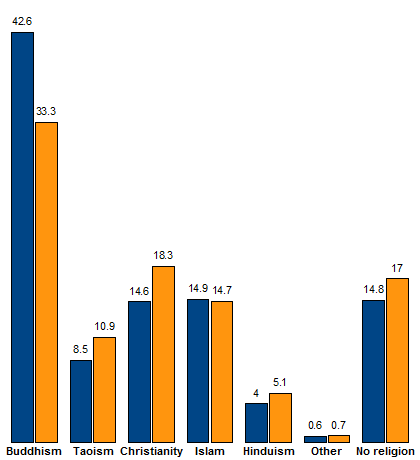
The other group to gain new followers was those with no religion - from 14.8 per cent in 2000 to 17 per cent last year.

What an unusual way to describe the non-religious... followers? of what? no religion?

Sociologist Daniel Goh, an assistant professor at the National University of Singapore, said the increase could have be due to overall higher education levels and the loosening of kinship ties in society. "Higher-educated people are more likely to look to a de-ritualized way of life. They want to be able to choose freely a belief system that works for them."

Yet another unusual phrasing - "choose freely a belief system".

We don't choose beliefs - We believe when we're convinced by the evidence (though evidential standards vary between individuals).

Morals not to be found in a book
Mr Eugene Tay, 23, is used to asking questions. It is something his parents have encouraged him to do since he was little.

"I was encouraged to use basic tools - logic, science - to analyze our world. If something isn't right, we ask why," said the third-year engineering student at Nanyang Technological University.

His spirit of inquiry and his leaning towards logic and science have built in him a non-faith. He calls himself an "atheist-agnostic, secular humanist".

Simply put, he does not believe in God.

About organized religion, he said: "Having a religion to me would seem like I'm forcing myself to a certain dogma that tells me what to do, what is morally correct or incorrect.

"There are ways to think about morals - and they don't all come in a book."

This seems like the first time I've seen, in the news, someone who explicitly identifies as an atheist-agnostic and secular humanist. Looks promising for one who hopes that more people become rational/skeptical atheists.

I take issue with the capitalization of "god" in the article. "God" when capitalized usually refer to God of Abraham - which is not the case here, here it should be "any gods" not "God".

I do love the swipe made against the authority of scripture - and the bookish religions.

2010 Census - Religion in Singapore

The 2010 Population Census of Singapore has just been released. The following is a graph representing the change in religious affiliation over the past decade. Blue represents the percentage of the population in 2000 and orange for 2010.


From the data, it is clear that all religious categories increased in proportion over the decade with the sole exception of Buddhism. Amongst those experiencing an increase, Christianity, Taoism, Hinduism and people who identify with "no religion" show significant growth. Islam and "other religions" remained relatively stable.

Figures tell that the younger generations are more likely to profess "no religion". The non-religious has seen an increase in proportion across alll age groups. Almost one in four university graduates had no religion - although this figure has fallen from 28.9% (2000) to 24.2% (2010).

The ethnicity of the non-religious seems to be almost completely Chinese, accounting for about 97% of those who profess "no religion". This number account for slightly more than one-fifth of the Chinese population.


Although 17% of Singaporeans identify with "no religion", it is not clear what fraction have reached the position because of skepticism. But in general, it is somewhat promising to see some increase in irreligiosity.

Singapore Census of Population 2010
There are no direct links to/quotes of the document in question due to copyright. The data represented here have been drawn from newspaper publications (The Straits Times, 13 Jan 2011) which presumably have been granted permission to publish these results.

While no direct links are allowed, you may visit SingStats by searching "statistics singapore" on Google. At the site, go to Publications", look for the document in question under "Singapore Census of Population 2010".

Religious harmony, really?

Recently, in the newspapers, there have been a couple of praise or mention of religious harmony in Singapore. One letter in the forum section of the Straits Times even commented that "The Prime News photograph yesterday (above) of Rabbi Mordechai Abergel, Buddhist monk the Venerable Fa Rong and Mufti Syed Isa Mohamed Semait nearly moved me to tears." (The Straits Times - ST Forum - Picture perfect harmony)


It's good so far
Before I continue, I need to say that I do like the fact that Singapore enjoys religious harmony. Religions do not make much issue here unlike some of our neighbours (such as Christianity vs Islam in Indonesia).

To be clear, I am all for religious harmony.

Now here comes the big "but",
But, I don't think that that is a solution in the long run.


Exclusivity of religious truth
Religions make truth claims. Unless the religion advocates the kind of universalism where it teaches that all religions are different paths to god(s), religions are mutually exclusive. No two religion can be simultaneously correct.

Look at Old Testament (Christianity) or Tanakh (Judaism) on the issue of other gods

From the Book of Deuteronomy (Tanakh/Bible)

Deuteronomy 17:2-7 (New International Version, NIV)
If a man or woman living among you in one of the towns the LORD gives you is found doing evil in the eyes of the LORD your God in violation of his covenant, and contrary to my command has worshiped other gods, bowing down to them or to the sun or the moon or the stars in the sky, and this has been brought to your attention, then you must investigate it thoroughly. If it is true and it has been proved that this detestable thing has been done in Israel, take the man or woman who has done this evil deed to your city gate and stone that person to death. On the testimony of two or three witnesses a person is to be put to death, but no one is to be put to death on the testimony of only one witness. The hands of the witnesses must be the first in putting that person to death, and then the hands of all the people. You must purge the evil from among you.


What about the Koran's (Islam's) view of Christianity,

From the Qur'an, the holy book of Islam

Qur'an 5:72-78 (Yusufali translation)
They do blaspheme who say: "Allah is Christ the son of Mary." But said Christ: "O Children of Israel! worship Allah, my Lord and your Lord." Whoever joins other gods with Allah,- Allah will forbid him the garden, and the Fire will be his abode. There will for the wrong-doers be no one to help. They do blaspheme who say: Allah is one of three in a Trinity: for there is no god except One Allah. If they desist not from their word (of blasphemy), verily a grievous penalty will befall the blasphemers among them.

Why turn they not to Allah, and seek His forgiveness? For Allah is Oft-forgiving, Most Merciful.

Christ the son of Mary was no more than a messenger; many were the messengers that passed away before him. His mother was a woman of truth. They had both to eat their (daily) food. See how Allah doth make His signs clear to them; yet see in what ways they are deluded away from the truth!

Say: "Will ye worship, besides Allah, something which hath no power either to harm or benefit you? But Allah,- He it is that heareth and knoweth all things." Say: "O people of the Book! exceed not in your religion the bounds (of what is proper), trespassing beyond the truth, nor follow the vain desires of people who went wrong in times gone by,- who misled many, and strayed (themselves) from the even way.
Curses were pronounced on those among the Children of Israel who rejected Faith, by the tongue of David and of Jesus the son of Mary: because they disobeyed and persisted in excesses.

I think I need not say more about the exclusivity of the truth claims of the fore mentioned religions.

Even without these intolerant ideas in their holy books, religions feeds off human tribalism. It fosters divisiveness explicitly or implicitly, creating a Us versus Them situation whenever it is deemed fit.


The inherent danger of reversion
Yes, I understand believers have various reasons to ignore or not act on behalf of their holy books. But the fact remains that those verses are in their holy books. A simple reversion to fundamentalism or literalism will unleash yet more evils of religion upon the society.

Religious fervor transcend educational and economic boundaries (and indeed, national ones). This is notably true in present day events. The perpetrators of the 9/11 attacks were educated Muslims from middle income families from different countries. There was the assassinations of abortion-providing doctors in the United States of America. Religion is clearly capable of inspiring insane atrocities.


Really harmony?
Is this harmony (in Singapore) we see truly what it seems?
Can it survive the religious fanaticism emanating from the rest of the globe?

Are the religions in Singapore really holding hands and skipping across the beautiful meadows of peace?

Or is it just begrudging tolerance - with religions sitting around a table with weapons behind them waiting for someone to say or do the wrong thing?

I am simply saying that we need to recognize this issue and actually address it. This fluffed up image of harmony fails to address this inherent danger of religions.

Peace does not come about by ignoring clear and present danger.