Showing posts with label Singapore. Show all posts

How "unfettered"?

Oh dear. It seems that my Singapore doesn't seem to see the difference between criticism and hate speech.

Channel News Asia has this article:

SINGAPORE: Deputy Prime Minister and Minister for Home Affairs Teo Chee Hean said freedom of expression does not mean that one has unfettered rights to insult and denigrate another's religion or race.

Rather, this freedom must be safeguarded through mutual respect of the views and beliefs of others.

Commenting on the film "Innocence of Muslims", Mr Teo said in a statement that it is also wrong and counterproductive to respond to this inflammatory and offensive film with violence.

Mr Teo said he is confident that Singaporeans will react to this film in the same rational and calm manner as they have done previously.

He added that "we should not let events overseas undermine the peaceful and harmonious relationships built up over the years in Singapore". 

I'm pretty sure I disagree (the comment on freedom of expression).

See the following two statements:

"Religious group X are human garbage / should all be shot dead / do not deserve equal rights."

"Religious group Y beliefs are factually wrong / evidentially unsupported / just ridiculous."

The law might justifiably come down against the former sort of statements. However, the latter should be "unfettered". It's the difference between hate speech and criticism -- and freedom of religion does not exempt one from criticism. You do not have the right to not be offended.

Ideally, sane people would never go so far as to riot and kill over being "offended". Yet, religious people do. The right thing to do is to jail the rioters -- not impinge on freedom of expression. Offensive speech would be regulated at a social level -- not legally.

Creationist Crap (in Singapore)

The church is doling out lies (as usual). And this one is about anti-scientific misinformation. The following image is taken from outside St Andrew's Cathedral in... Singapore. Yes, American creationist crap on display at an Anglican church in Singapore.


I'll ignore the large chunk of text that constitute the bottom half of the poster. If you want to believe the words of a compilation of books written by unknown authors, probably altered by innumerable scribes through the ages, about stories transmitted orally for centuries by a Bronze Age tribe of desert nomads who have no scientific knowledge whatsoever, that's your thing. I don't think that is prudent to say the least. But if you want to call it your holy text, whatever.

I take issue with the top half, just three line stating:

The Theory of Evolution is false!
Even science has discovered that.
Human beings are not descended from apes.

False. Lie. Trivially true.

Firstly,

The Theory of Evolution is false!

Wrong. That's one of the stupidest thing anyone can state about biology.

The Theory of Evolution is one of strongest scientific theories around. Some would even argue that it's the strongest theory we have. Every piece of evidence gathered thus far are in agreement with the theory. In addition, the Fact of Evolution is not in dispute at all; Biologists may be working on the details in the theory but no sane scientist would challenge the Fact itself.

So, if you believe that the theory of evolution is false, go get educated. Seriously.

Check out:
Evolution 101
The Scientific Case for Common Descent

And if you prefer videos, check out my playlists:
The Collapse of ID (Kenneth Miller lecture)
Evidence for Evolution
Foundational Falsehoods of Creationism (Content-heavy Youtube series)
Intelligent Design on Trial (Nova Documentary)
The Genius of Charles Darwin (BBC Documentary)


Next,

Even science has discovered that.

Wrong. Again. The theory of evolution is accepted amongst scientists in general. But more importantly, accepted by biologists.

By the way, a few fringe biologists and non-biological scientists dissenting does not demonstrate the rejection of the theory. I hope this doesn't require explanation.

Regarding the scientific consensus, the Wikipedia has a rather comprehensive article on the issue. Check that out. The National Center for Science Education (USA) has some information on the scientific consensus as well.


Finally,

Human beings are not descended from apes.

Only trivially true. Because, while we didn't descend from modern apes, we ARE apes.

If "apes" in that statement is taken to mean "modern great apes", then yes, we cannot have evolved from modern animals. That makes no sense. The theory of evolution does NOT make such a obviously false claim.

However, we DID evolve from a common ancestor that we share with Chimpanzees, Bonobos, Gorillas and  etc. It makes sense to call the common ancestor an ape since it would have the characteristics of one. In that sense, we ARE descended from apes.

This video should shed some light on how this is the case.


To end off, I want to say that it is arguably fine and dandy for creationists to hold their religious beliefs about the origins of humanity. Freedom of religious belief is granted in Singapore. However, if you cross the boundary and make factual claims about reality, then be assured that there will be people  to call you out on your lies.

Additionally, making something a matter of faith does not render it immune to rational criticism. If a religion were to claim that 2+2=5 on the basis of their religious faith, they would be factually completely WRONG. Similarly, it would be just as wrong to claim that evolution is false.

Science is evidently NOT on the side of creationist religious claims. Evolution is a FACT and the THEORY have overwhelming support from the scientific community. To state the contrary is to LIE (by the way, doesn't that contravene the 9th commandment?).

Pulling Jesus out of FHM

In an act of deference to religious hypersensitivity, FHM Singapore is pulling its latest issue off the shelves because of two articles that were described as "highly objectionable and deplorable" by the National Council of Churches of Singapore (NCCS).

TODAYonline reports in the article "FHM pulled off selves, editor apologises":

SINGAPORE - The National Council of Churches of Singapore (NCCS) has sharply criticised two articles published in the latest edition of FHM Singapore, describing them as "highly objectionable and deplorable". The criticism prompted an immediate apology from the senior editor of the men's magazine and the removal of the publication from newsstands islandwide.

In a statement yesterday, the council, which represents more than 150 churches across denominations, said the articles "make fun of the Lord Jesus Christ". The statement, signed by NCCS president Bishop Dr Robert Solomon and its three vice-presidents, added: "These articles appear during the holy season of Lent when Christians remember the sufferings and sacrifice of Jesus on the cross, and they cause serious offence and hurt the sensitivities of the Christian community."

The NCCS also urged the authorities to "look into the matter and ensure the material in question is removed", adding that "such offensive articles threaten the religious harmony that we work so hard to build and maintain".

Noting that it has become "fashionable" to depict religions in the media in ways that are offensive to religious communities, the council urged that "society must be on guard against such trends". FHM Singapore is a title produced by MediaCorp Publishing. The articles in question were entitled "Which of These Celebs Might Secretly be Jesus?" and "Jesus 2.0: What can we expect?".

When contacted, FHM Singapore senior editor David Fuhrmann-Lim said: "We would like to apologise for any offence caused ... We are always sensitive to people's religions and beliefs, and while the article was written with a tongue-in-cheek humour, we do realise now it was not done in the best taste or judgment. We will certainly be more mindful of such sensitive issues in the future."

"Furthermore, we will immediately remove all copies on sale in the newsstands; this process should be completed in the next two days," he added.

When contacted, a spokesperson for the industry regulator Media Development Authority said: "We are investigating this complaint for a possible breach of our content guidelines for publications."

Let's see what do we have here. We have religious hypersensitivity being used to justify censorship. We have religious folk who don't differentiate between humor and malice. We have a business kowtowing to religious bullies. We have the same meaningless "FOR religious harmony!" rhetoric being employed. We have the authorities being invoked to possibly penalize the expression of unpopular speech.

On a side note, why are these good Christian folks reading FHM? Oh wait. My bad. All their sins are forgiven so what would a little lusting hurt anyways. Duh.

Back to the topic; There's really not much left to talk about. This nonsense is small compared to the bigger nonsense that is our social-legal environment here. Religions are accorded undue respect and influence on our freedom of speech here in Singapore. There is no reason why such humor should be censored because some religious folks are "offended" that not everyone has nice things to say about their sacred stuff.

Imagine if the Prophet Muhammad was depicted instead. Given the climate in Singapore, I'll be surprised if no one was prosecuted under the Sedition Act. Yet, it should be allowed just as FHM shouldn't be censored. But then again, the authorities would simply give in to religious pressure because those religious folks might riot over such inane offense.

Singapore. Where we wuss out to religious hypersensitivity.

Religious Non-harmony

Okay. I mentioned it before: I don't actually think that harmony between religions is ever possible. Unless religions somehow stay completely outside social interactions, harmony will break soon or later.

Religions make assertions about the world. Different religions make contradictory assertions. These assertions inform the beliefs which in turn inform actions. Actions have consequences -- and in the case of actions based on opposing beliefs, the consequence is frequently conflict.

That's a simplified way of explaining why religious harmony is ultimately not possible unless all religions agree (in which case there is only one religion) or one religion takes over the world by brute force and silences all dissenting opinion. The third option is for everyone to recognize that all religions are false and skip requiring "religious harmony" altogether.

And now onto a little viewpoint published in the Straits Times (ST Forum online):

Religion
'Learn to have an open, mature discussion without getting worked up.'

MR MICHAEL ANG: 'To strengthen racial harmony, Christian evangelists need a less intrusive method of spreading their message, while Singaporeans should learn to have an open, mature discussion of major religious differences without getting all worked up ('Christian group says sorry for remarks'; last Friday). Religious harmony can be better solidified, not through finding similarities among the major religions in Singapore but through understanding one another's deep doctrinal differences. As much as non-Christians should refrain from branding every form of Christian evangelism as undesirable proselytising, Christians should spread Christ's message without pestering non-believers to follow the religion. Such an evangelistic approach would, hopefully, help to reduce any disruption to Singapore's religious harmony.'

I can see how people may think that is fine and dandy. Sounds pleasant, doesn't it? A call for more or better religious harmony. So nice and sensible.

I actually think it's rather vacuous. Sorta missing the point a little as well.

Let's take a look line by line.

To strengthen racial harmony, Christian evangelists need a less intrusive method of spreading their message,

"Don't be a dick when spreading the word of god"; Sounds reasonable.

Might work with non-believers who believe in debate and discussion and would peacefully discuss about the evidence that bears on the question of whether your religion is true.

What about a religious believer who believes in his own religion being the one true religion, that non-believers are damned to hell and should ideally be killed if they so dare spread lies (false religions)?

Those are extreme of course. But what about those in between? Some may think it's okay but others might think it's plain offensive. Again, "harmony" is likely shattered.

while Singaporeans should learn to have an open, mature discussion of major religious differences without getting all worked up.

This, I thought, downplayed what transpired. Perhaps there were some folks who got worked up because some Christians were proselytizing against Buddhists, but there are other opinions. I'm of the opinion that asserting that non-believers of your religion can't possibly be happy (expressed in the poster) is plain bigotry.

I don't care what religion or non-religion you belong to. If that's your position then you're an asshole. Even atheists don't claim religious people can't be happy because they're religious. Barring perhaps brain/emotion experts, who the fuck are you to say that?

Religious harmony can be better solidified, not through finding similarities among the major religions in Singapore but through understanding one another's deep doctrinal differences.

I'm not too sure what's this supposed to mean. Understanding differences? Probably. But you probably won't be religious as well then.

I submit that if one were to actually understand what and how differences between religious doctrines come about, one would deconvert and be an atheist. I doubt anyone who studies comparative religion would still proselytize for a single religion with evangelistic fervor.

As much as non-Christians should refrain from branding every form of Christian evangelism as undesirable proselytising, 

Again, it's not the method that drew the attention, it's the message. Bigoted beliefs are undesirable regardless of the method used to spread.

Christians should spread Christ's message without pestering non-believers to follow the religion. Such an evangelistic approach would, hopefully, help to reduce any disruption to Singapore's religious harmony.

Yea, sure. I'd like to see how that happens without evidence on any religion's side.

Until the majority of Singaporeans realize that there is and never was any evidence for any religion and therefore abandon their vacuous beliefs, I find it difficult to envision "religious harmony" with all the religions running around thinking that they have the truth.

NUS Crusaders' Not-pology

Just a day after a photo of its poster spread virally over the social networks, the NUS Campus Crusade for Christ took the posters down and issued an apology. The Straits Times online article reports:

A Christian student group at the National University of Singapore (NUS) apologised on Thursday for making insensitive remarks about Buddhists and Muslims.

The NUS Campus Crusade for Christ, made up of 80 to 100 students, posted an apology on its Facebook page for remarks made on its website and on posters it put up on campus benches on Wednesday.

The university also apologised on Thursday. The Ministry of Home Affairs, which is looking into the incident, said that while people are free to propagate their religion, it should not be done by insulting or denigrating other religions.

The Christian group's posters promoting a mission trip to Thailand said that the country, known as The Land of Smiles, was actually 'a place of little true joy'.

The NUS Campus Crusade for Christ has the following apology on their Facebook wall:

Dear Netizens,

We humbly apologize for the distress we have caused you through the poster of ours that has gone viral online. We recognize that our choice of words used should have been more sensitive and tactful. We acknowledge that everyone is entitled to their own beliefs and it is definitely not our intention to force anyone to believe in what we do.

We have since removed our posters and websites, and will be watchful of future actions. Thank you for your understanding and our deepest apologies again for the distress that this incident has caused you.

With sincere apologies,
On behalf of NUS Campus Crusade

What's the poster that caused this explosion of attention on intolerant/bigoted ideas? You can check it out here at YawningBread where there is too an article on this incident.

Now back to the apology. Notice the statement "We recognize that our choice of words used should have been more sensitive and tactful."? There is not an apology for the bigoted idea expressed in the poster. Rather it's apologizing for the tactless way in which it was phrased. Sweet, huh?

Yet, I would consider it typical or, at least, logical that a Christian would endorse the poster. After all, if you sincerely believe that your religion is the ONE TRUE religion and that you can only experience TRUE happiness by following that religion, then that IS what you would say to non-believers of your religion. To  do otherwise would be being inconsistent.

But the thing is, it is a bigoted idea. So there you have all the other religionists jumping in to say that that is intolerant, insensitive or plain wrong. Liberal Christians jump in to say essentially "that's not what our religion is about".

Some people stated that freedom of religion allows for such offensive speech. Others say that religion or not, bigoted ideas are a no-no.

So how does this resolve in Singapore? Combine the two. You have the freedom to have those beliefs but you cannot express them (lest you cause a fracking riot or something).

That is why I have said before: Religious harmony in Singapore is not religions running happily through the green meadows but an uneasy roundtable where a wrong move by any one religion triggers a free for all; "Harmony" is a euphemism for begrudging tolerance here.

The former is what I suspect most people want (but I contend is impossible) but the latter is what Singapore produces. And that is unhealthy for our society -- we're simply waiting for disaster.

Seriously MOE? Abstinence?

At the time of writing, the following two news articles reported the Ministry of Education's drafting of a revised Sexuality Education Programme (SEP):

From Yahoo! News (SG)
A new focus on sexual abstinence

The Ministry of Education (MOE) has drafted a revised Sexuality Education Programme (SEP) to boost emphasis on abstinence over contraception, reported The New Paper (TNP).

The new programme, Breaking Down Bridges (BDB), will be taught to Secondary 3, first-year junior college and centralised institute students, said the paper.

TNP also reported that the old programme faced some criticism from some Catholics due to the emphasis on using contraception, and the lack of awareness given to abstaining from sex. While it understands from MOE that the new programme will be ready in 2012, no details have yet been confirmed.

An MOE spokesperson told TNP that the revamp is part of its "periodic review" of the SEP curriculum to "ensure that it is updated and relevant" to students.

Parents of students in Catholic schools in Singapore welcomed the change to the programme.

Yahoo! Singapore spoke to Marilyn Koh, 47, a Catholic whose son attends a Catholic school, "I'm really looking forward to MOE changing their focus on the SEP. I was not very comfortable with the previous curriculum as it was not catered to Catholic teachings."

Francis Chan, who also has a son in a Catholic school, agreed with the change, "It's a lot more appropriate for Catholic schools to be teaching the children to abstain from sex, instead of promoting contraception. I'm perfectly fine with the current programme running in a secular school, but Catholic schools should be imparting Catholic values, right?"

And,

Online article by The New Paper
Sex-ed revision sparks questions

CONTRACEPTION may have to give some way to abstinence in a revised version of a Sexuality Education Programme (SEP) here.

The New Paper understands that a draft of this revised SEP for all schools here has already been drawn up – and that the 30 or more Catholic Schools here should find fewer issues with it.

Some communities find sections of the current programme overly promote the use of contraception, and lack emphasis on abstinence.

They are especially offended by a video showing how a condom should be used.

Others, however, are concerned about what the refreshed programme will entail.

The articles are not clear about what is meant by "boost emphasis on abstinence over contraception" and "contraception may have to give some way to abstinence". Is MOE adding some emphasis to sexual abstinence, reallocating emphasis to abstinence away from contraception or actually going for the "abstinence only" nonsense?

Secondly, why is Catholicism explicitly brought up in the articles? Again, is MOE placing additional weight on the "moral teachings" of Catholics over the well being of ALL students? No religion should hold sway over the secular (sexual or otherwise) education of students through their own religious teaching. There should be no sectarian bias in any of MOE's education programmes

Another point: Shouldn't sexual education be primarily decided by the Health Promotion Board instead? I'd think that sex ed. should be taught based on the science and data instead of religious "morals".

So, MOE, whatcha doing actually?

Creationism Attack on Singapore

It has just come to my attention that Singapore is actually one of the 7 countries targeted by Creation Ministries International's "Question Evolution" campaign.

So if any Singaporeans has visited my blog, please be aware of this piece of religious nonsense attempting to spread itself further within our communities.

For more information and resources on the alleged Evolution-Creationism controversy, do visit the following sites:

This US non-profit organization has been defending the scientific theory of evolution for more than 2 decades. Check the site out for information pertaining to anti-Evolution movements by creationists in the US.


The TalkOrigins archive is home to the Index of Creationist Claims where practically all creationists claims has been answered/refuted. This is a quick resource for people looking for answers from mainstream science about creationists' "questions".


Creationism's pseudoscientific disguise, Intelligent Design, has been demolished in a federal court. The event was made into a NOVA documentary. This is worth a watch!


15+1 Youtubers, Christians and non-believers, has put together a 4 part video series to answer/rebut the 15 questions from the Question Evolution Campaign.


For those who enjoy being immersed in a stream of information, check out AronRa's Foundational Falsehood of Creationism series on Youtube.

Jesus Camp, Singapore

By the way.

HOLY FUCK! The conservative Christian pastor, Becky Fischer, well-known for running Jesus Camp, was in Singapore.


For those who haven't heard of Jesus Camp, you can see it on Youtube.


Part 1: http://www.youtube.com/watch?v=gHa1D4ioMBM
Part 2: http://www.youtube.com/watch?v=DkKCeWbmEjw
Part 3: http://www.youtube.com/watch?v=FjpmVtqtw90
Part 4: http://www.youtube.com/watch?v=wssdo_L56pI
Part 5: http://www.youtube.com/watch?v=9JXoQOX8VE0
Part 6: http://www.youtube.com/watch?v=TFw14ATOgew

The crazies are coming!

Open, tolerant and respectful

I am guessing that most Singaporeans should have noticed that when it comes to racial or religious harmony, our government always reiterates the same points with the same rhetoric all the time. Don't get me wrong; I do agree that we should maintain racial/religious harmony -- that's not the issue here.

What gets on my nerves is how vague they are every single time that I've seen it. It's always the same vague language, imploring that we should be open, tolerant and respectful of other beliefs. Okay, good. What does that mean?

What is being open?

To be open is to be ready to entertain new ideas. And here in Singapore, I never really thought that this was an issue at all (so far).

What about being tolerant?

To be tolerant something is to permit and endure its existence. Again, I, for one, have no issue with this. I am not, and I hope nobody else is, going to prohibit religion or irreligion in general.

Then what about being respectful?

To show deference to a right. Sure, people have the right to have or not have religious beliefs -- that's fine.

What then is the issue here?

Wait, there's another commonly used meaning for respect I'm forgetting -- to hold in esteem or honor. That? HELL, NO.

Now, think of the common thread that holds this 3 terms together. For non-believers on the internet, I'm pretty sure you might have guessed it -- Criticism of religious doctrines and practices.

In the eyes of (some of) the religious and squishy liberals, simply criticizing religious doctrines and practices is equated to being close-minded, intolerant and disrespectful. Guess what? They're wrong. One can be open, tolerant and respectful of religious beliefs without silencing all opposing ideas (ie, criticism).

I will entertain your beliefs, respect your right to hold them, tolerate your practices AND tell you what I find disagreeable. But the last part is what seems to get their goat. And that appears to me, what they wish to achieve with the usual rhetoric.

When tensions between religions (and the irreligious) mount around the globe, the rhetoric is used to quell any tension that might be building here in Singapore. In this case, it might have been the tension between the freethought community and the religious in the USA and Europe.

It becomes ironic when you consider what happens when religious conflicts do escalate. It ends with one religious faction making a hell of a fuss by rioting. So essentially, I cannot criticize you because you might lose your sanity and kill people -- and this is supposed to be acceptable?

For example, if a riot broke out because a group of people were unhappy with the government's decision, those people are insurgents. But if a riot broke up because a group of people were unhappy because they were presented facts about their religion, those people are good citizens who should be protected from information? Bite me.

I genuinely hope the that is not the position the government is holding and is possibly using that same old rhetoric about religious harmony for more benign reasons.

To summarize, my position is that, I will defend your right to believe in nonsense so long as you do not deny my right to call it nonsense.

Happy Birthday Singapore!

Today marks the 46th year of our island nation's independence.

In keeping with tradition, this year we have "In a Heartbeat" for our National Day Parade theme song.


I realized I did not have a post up for last year's National Day (probably because I'm busy being involved). So here's last year's song as well.


Sometimes I ask myself, why do I like NDP songs (here's an almost complete playlist of them, excluding 2010 and 2011) so much.

I think I know why now: I always picture the whole world singing the song, not for just Singapore, but for the whole world -- a world united...

I've no god - and am proud of it

 The following is an article by the Straits Times via Jakarta Globe:

Singapore. A growing number of people in Singapore who do not believe in a God have banded together, determined to be unapologetic about being non-religious.

Registered as the Humanist Society (Singapore) last October, their ranks have since expanded from 10 to 100 registered, fee-paying members.

Their backgrounds are as diverse as their reasons for not professing a faith, but they are united by their belief that morality comes from humanity itself.

Calling themselves 'secular humanists', they are also united in their rejection of a theistic or supernatural explanation of reality, and their embracing of scientific inquiry.

Today is a red-letter day: The society presents its inaugural Humanist of the Year award to author Catherine Lim.

Another recent milestone was the society's application to join the International Humanist and Ethical Union, a European body of humanist societies around the world.

The humanists here include artists, government officials, students and entrepreneurs. The youngest member is 19 and the oldest, 65.

Most describe themselves as atheists or agnostics, though some eschew labels. Others are adamantly definitive. Take Nanyang Technological University student Eugene Tay, 24, who declares: 'I'm an atheist-agnostic secular humanist.'

Statistically, the proportion of people here with no religion has climbed steadily in the last 30 years - from 13 per cent in 1980 to 17 per cent last year.

Since non-believers have no church, temple or mosque to go to, they have carved out their space online.

The founding members of the Humanist Society came together in 2008, through www.meetup.com, a social networking website.

The online group they formed has more than 500 members.

Since it was set up, the society has cast itself as the voice for the non-religious here. Its president Paul Tobin, 46, wrote to The Straits Times' Forum page last December, in response to a report that suggested that non-religious young people were prone to violence and cynicism. In his letter, he rejected the claim and concluded: 'One does not need to have a religion to lead a good, happy and meaningful life.'

He told The Straits Times: 'That was a watershed moment. After that letter, our numbers shot up. I feel now that we have a say in what goes on in Singapore.'

Land surveyor Loh Kwek Leong, 58, who learnt of the society through this newspaper last year, said he grew up in a typical Chinese household - one that was 'a bit Taoist, a bit Buddhist, a lot superstitious'.

As an adult, he found putting his faith in science better. He said: 'The questions I had about the world, about life and death - I found my answers in science, not religion.'

The group pulls together because of a shared sense of being alone in a society where four in five people profess to believe in a Supreme Being.

Communications manager Winston Chong, 36, who said he has philosophical debates with his parents, who are religious, said: 'It's about time we had a group for ourselves. I've been waiting for this, to find like-minded people.'

As a recipient of the society's award, Dr Lim joins a list of internationally honoured humanists, including astronomer Carl Sagan and evolutionary biologist Richard Dawkins.

Asked for her take on religion, she replied via e-mail: 'I suppose if I had a religion, it would be the 'religion of humanity', based on confidence in the indomitability of the human spirit. I would rather have faith, than a faith.'


If I want to be pedantic, I'll take issue with capitalizing the word "god". Excuse me, are you trying to be a bigoted monotheist, dismissing all the other gods other people believe in -- hmmm?

I also take issue with the phrase "putting his faith in science" because it reeks of religious language that confuse the issue of faith, trust and confidence.

But all in all, nice -- a positive article about secular humanism and non-belief is always good to have.

Secularism, what is that really?

Okay, let me put it upfront that the article I'll be referring to is old news, really old news, like 2009 old news. Unfortunately, the nonsense in the article is not unnecessarily old. It does seem that Christians in Singapore are importing American Evangelical nonsense. I will use this opportunity to clarify what secularism is and is not.

There seems to be few sources that have the interview of Thio Li-Ann archived. So I'll be using this one archived by AWARE. It should be sufficient for my purposes since I'm not going to be deconstructing the whole interview. If you want that, then I would recommend this other blog's post - it's quite well done I think.

Historically, ‘secularism’ originates from the Latin ‘saeculum’, meaning ‘temporal’, worldly affairs, rather than ‘spiritual’, other-worldly matters. The word ‘secular’ is an emblem of intense historical conflict.

Today, in some circles, ‘secularism’ connotes systematic hostility towards religion, as a synonym for a politicised form of ideological atheism whose creed is that humanity is destined to wholly shed religious conviction. The atheistic word was made flesh in the atheistic state produced by the Russian Revolution of 1917, devoted to Marx’s assumption that religion stupefies the masses and must be eradicated to bring forth the new Communist Man.

......

In 1989, Foreign Minister George Yeo observed the Government was ‘secular but it is certainly not atheistic’. This evinces a rejection of a thick, atheistic version of secularism.

Here is a truncated quote from the interview. Notice the attempt to confuse and conflate atheism and secularism?

Guess what? Secularism and atheism are two completely different things. This attempt to confuse the issue is a dishonest ploy to evoke feelings of opposition to secularism from religious folks.

For the record, if the state/government endorses atheism or antitheism, it is by definition, NOT secular. As such, there is NO such thing as an "atheistic version of secularism". Secularity of the government only means that the government just remain neutral in matters pertaining to the religious beliefs of its citizens.

Secular humanism, which posits a morality independent of God, is a comprehensive anti-theistic world view. Some courts recognise it as a religion. It dogmatically asserts the absence of God, without any empirical evidence. We know from elementary logic that it is impossible to prove a universal negative. Whether God exists or not cannot be proved or disproved by evidence or logic.

It takes faith to believe or not to believe in God or gods. A lot of faith is needed to believe there is no divine. As Turkish journalist Mustafa Akyol wrote: ‘It is the atheist’s opium to regard that unsubstantiated faith as established fact.’ Thick secularism is thus an anti-religion religion.

Again, an attempt to conflate secularism with atheism, this time, as well as Secular Humanism.

It's important to go through this point by point to clarify the confusion about Secular Humanism.

Secular humanism, which posits a morality independent of God, is a comprehensive anti-theistic world view.

Secular Humanism is atheistic in nature though not necessarily antitheistic.

Here is the Minimum Statement on Humanism:

Humanism is a democratic and ethical life stance, which affirms that human beings have the right and responsibility to give meaning and shape to their own lives. It stands for the building of a more humane society through an ethic based on human and other natural values in the spirit of reason and free inquiry through human capabilities. It is not theistic, and it does not accept supernatural views of reality.

Secular Humanists themselves may be antitheistic but it is not a dogmatic requirement of the stance. In fact, Secular Humanism rejects dogmas.

Some courts recognise it as a religion.

The recognition of Secular Humanism as a "religion" is for functional reasons in the eyes of the law.

It dogmatically asserts the absence of God, without any empirical evidence.

No, it doesn't. That has it ass backwards.

Precisely because there is no empirical evidence FOR the existence of god(s), Secular Humanists do not believe there is/are god(s). The distinction between "do not believe in the existence of god" and "believe there are no gods" is subtle but still important! We simply do not pretend there is one (or more gods) - instead we believe only we, humans, can help ourselves (hence the humanist aspect).

We know from elementary logic that it is impossible to prove a universal negative. Whether God exists or not cannot be proved or disproved by evidence or logic.

Gee, except that's not what we're claiming - we haven't disproved god nor can we.

While we can't prove (in correct usage of the word) the existence of god(s), we should be able to demonstrate IF he/she/it exist. But we haven't; Still waiting for those people with the burden of proof to bring in the evidence.

And now we'll move onto the rest of the nonsense.

Secular democracies should be neutral not only between traditional religions but also regarding modern religions with atheistic foundations.

What in the world is "modern religions with atheistic foundations"? Some forms of Buddhism is atheistic but that sure isn't modern.

Again, it seems that this is yet another attempt to claim that atheism somehow constitutes a religion. Well, it isn't. Being an atheist effectively means having no religion. Lacking belief in god makes you an atheist; No rational atheist asserts that god(s) do not exist and even those who do make that assertion are not organising a religion!

But let's move straight to most important part, the biggest "misunderstanding",

Thus, Singapore secularism is 'agnostic' and 'thin'. The Government does not favour or disfavour any particular religion. We practise 'accommodative secularism' described by the Court of Appeal as removing restrictions to one's choice of religious belief. Religious values do have a role in public debate.

Agnostic secularism of this sort is a virtue; it is a 'framework' which facilitates the peaceful co-existence of religions.

Conversely, militant secularism is an illiberal and undemocratic vice in seeking to gag religious views in the public square and so to privilege its atheistic values, as in communist states.

Secular fundamentalists are oppressive where they seek to mute religiously informed convictions in public debate, by demonising a view as religious.

The distinction between "accommodative" and "millitant" secularism is fucking nonsense.

Okay, I won't be quoting anymore. Here on is my explanation for secularism.

Secularism is one of the constitutional devices that sought to protect the people from the state (government) and vice versa, in this case, from religious discrimination. It means that the state must remain neutral towards religion, that is, the state cannot endorse any religions (no preferential treatment, no favorite or state religion) and cannot discriminate against any religion. This guarantees freedom of religion (as well as from religion).

Maybe it would be clearer if I used hypothetical examples.

It means the government cannot come out tomorrow and announce that Buddhism is the state religion of Singapore and its temples will now enjoy tax free status that other religions are not entitled.

It means the state cannot proclaim that we have amended the Singapore Pledge and it will now read:

We, the citizens of Singapore,
accept our Lord Jesus Christ as our one and only savior,
regardless of race, language or gender,

It means we cannot write into our law that all pork and pig related products shall be banned and no non-halal stalls will ever be permitted.

It means the Prime Minister cannot proclaim that we will now endorse state atheism and will now print "One Nation under No Gods" on our dollar bills.

Clearer now?

Secularism also means that members of the government cannot inject their religion into our constitution, our laws or anything endorsed by the government.

We may not inject Creationism into our national Science curriculum at our public schools.

We may not criminalized abortion on the basis of any religious doctrine.

We may not discriminate against homosexuals on the basis of any holy text.

We may not allow state-led prayer in our Parliament or public schools.

And yes, those examples come from America where religious nuts are trying to destroy the secularity of the USA.

To put it simply, secularism means you cannot impose your religious views on others via the government but neither can the government tell you what you can or cannot believe/do because of someone else's religion.

I hope you can see that that's a good thing, otherwise, you might be a bigot or possibly a theocrat... just guessing...

Reviewing the Integration Controversy

It seems that the controversy has died down. The Straits Times did a review titled "Reflections on being Muslim and S'porean" today (10 Feb 2011) wherein it published several commentaries, that ran in Berita Harian and Berita Minggu (both sister newspapers for Malay audience), which were written in response to MM Lee's comments regarding Muslims and social integration.

While I didn't agree with every point made in those commentaries, it was heartening to see that these responses were more measured and rational - engaging in discussion instead of dismissing it - and not of the "OMG, you're offensive - I don't want you around" variety.

One particular commentary by Maarof Salleh (BH, Feb 3) gladdened me. It was the one titled "Understanding the integration controversy".

Numerous criticisms poured in, many claiming that MM Lee was insensitive. Unfortunately, the criticisms were mostly emotional and defensive.

When the dust has settled, hopefully there will be more detailed, sensible, wise and intellectual debates.

I love this part of the commentary. Finally somebody echoing my views expressly from (presumably) within the Muslim community.

The same author goes on to point out the core message of MM Lee's comments which were completely overlooked by some earlier responses. He also notes that MM's suggestion of relaxing religious observance was essentially idealistic - this I do agree with.

For instance, MM Lee is concerned about religious overzealousness. This warrants careful consideration.

......

I see MM Lee's views as touching more on the issue of social cohesion, which is necessary for a young and pluralistic nation such as Singapore. Enforcing social unity by asking people to be less strict in their religious observances, although a rational argument, does not guarantee success.

The other commentaries all address the issue of Muslim social integration from their angles. But it is obvious that the general theme for most of the commentaries is that people need to be more mature or rational and deal with the criticism as such.

I like this little bit from an excerpt too.

Issues of language, race and religion are usually sensitive. Even followers of the same religion have misunderstandings and conflicts due to different views.

What is disconcerting is that some external parties try to wade into the controversy to take advantage of the situation.

I think this might be a quick swipe at some Malaysian leaders. Nice.

This is probably the end of the "controversy". And this will possibly be the last entry about this issue as well.

More Muslims respond to MM Lee

After the initial responses to MM Lee Kuan Yew by the Malaysian leaders, reported on 26 Jan 2011, more responses continued to appear in newspapers. Not surprisingly, a majority of those responses are from Muslims. In my observations, these responses can be grouped into 3 categories.

The first, and possibly the most common response, is to take offence at the MM's comments. Such was typical of the responses offered by the Malaysian leaders in the first article in response to the MM. Responses along these lines is typified by claims that Muslims sensitivities were ignored and that the comments have caused the community hurt. Occasionally, a good old personal attack is thrown in as well.

Here's a nice example

Right-wing Malay rights group Perkasa slammed Mr Lee, saying he seemed to be adapting the same tactic as non-Muslim opposition leaders in Malaysia who raised sensitive issues without bothering about Muslim sensitivities.

Perkasa secretary-general Syed Hassan Syed Ali: “Perkasa does not consider [MM Lee] Kuan Yew as being less able to respect other religions, but instead, consider him as a very senile old man.”

MM's remarks on integration draw flak
(The Straits Times, 26 Jan 2011)

Such responses do not warrant any response other than "Sorry, deal with it." Unless they're going to actually address what the MM is saying, there's really nothing to respond to.

The second kind of response are those of the "defence of the faith" variety. These responses usually say that the MM is simply wrong because Islam teaches religious harmony as well and is therefore do not hinder integration. Here's one such response from Singapore Muslims organisations reported by TODAY:

On Thursday, the Islamic Religious Council of Singapore (MUIS) had said that Islamic teachings do not hinder Muslims from integration in Singapore society. AMP echoed these views and said that "a good Muslim is duty bound, in Islam, to be a good Singaporean".

Muslim bodies irked by MM's remarks
(TODAY, 29 Jan 2011)

Well, good for you. I am glad that that is what your version of Islam teaches although I do hope that you embrace reality soon. Arguments about "true Islam" holds no water with me and are not of my concern.

The third response tend to be more rational/measured. The counter claim that they offer is that Singapore Muslims are integrating with the rest of Singapore and therefore the MM is either simply wrong or overstating the case. Here's an example:

But Perdaus feels that the level of integration "has significantly progressed" and "a better understanding and appreciation" of Singapore's cultures now exist between Muslims and non-Muslims here. It cited the community's participation in Inter-Racial and Religious Confidence Circles and contributions by humanitarian relief organisation Mercy Relief as examples.

Muslim bodies irked by MM's remarks
(TODAY, 29 Jan 2011)

I think that such responses kinda missed MM Lee's point. He is not claiming that Singapore Muslims are not integrating - he is claiming that the integrations was poorer when compared to other races/religions. Here is the relevant comment by the MM.

"I think we were progressing very nicely until the surge of Islam came, and if you asked me for my observations, the other communities have easier integration - friends, intermarriages and so on, Indians with Chinese, Chinese with Indians - than Muslims. That's the result of the surge from the Arab states."

MM's remarks on integration draw flak
(The Straits Times, 26 Jan 2011)

Religions, in general, are divisive so it might seem unfair to pick on Islam. But it does seem obvious that Islam has less buffers to tribal behaviours. Christianity has a huge emphasis on proselytizing and thus appears friendlier to people. Buddhism and Taoism behave more like life philosophies in general and thus create less/no threat to religious harmony. Smaller religious groups exert less influences by virtue of being small. Islam, well, other than claiming it teaches religious harmony, has no such "buffers". This might be the reason why MM made his claim.

So that's my take on the responses so far.


As I was doing research for this entry, I found something disturbing. PKMS, the Singapore Malay National Organization, has called for MM Lee to be investigated for sedition. According to their press statement, it said,

Is it not that Mr Lee Kuan Yew's statements are distorting and inciting racial and religious disharmony? Does it not fall under the Internal Security Act? Mr Lee championed the Internal Security Act (ISA), is it not Mr Lee himself breached the act openly and disrespectfully? Can the book 'HARD TRUTH' be a subversive document and should be classified under the Sedition Act (Cap 290) and shall fall under The Internal Security Act Chapter 3 (Special Powers Relating to Subversive Publication etc.)?

In addition to that, the statement also said,

We urged MUIS, as the highest Islamic authority in Singapore, advise Mr Lee Kuan Yew of the true teaching of Islam. Does Mr Lee's statements incite sentiments of protest among our Muslim brothers and may cause religious disharmony? We have also heard echoes of agreement from followers of other religion, who agree to Mr Lee's statements and they had even suggested for eradication of the Muslim in Singapore. Is Mr Lee's book subversive and cause of hatred and excite disaffection against Islam?
We demand Mr Lee Kuan Yew to apologize to the Singapore Muslim community and the Muslim world in general. We demand the book 'HARD TRUTH' be strictly banned and condemned.

This is religious lunacy. MM Lee's statements cannot be regarded as seditious under the law if the law is to be meaningful at all. Granted, I am no lawyer, they might be right to the letter of the law but this is clearly not the spirit of the law. The Sedition Act is intended to prevent religions from turning onto each other. But in this case, it is being used to essentially censor any form of speech critical of religions.

If Singapore, and the world, is to make any progress, then such speech must be permitted. If people take offence at such discussions then clearly that is their issue - people do not have the right not to be offended.

Nobody is disparaging anybody's religion with thoughtless remarks. It should be clear that there is a difference between

Muslims are [Insert vulgarity or insult here].

and

Muslims are integrating less smoothly than the other religions/races.

The MM's statements were essentially arguments for his point - a rational person should engage his arguments in a reasoned discussion. We should not be shutting down people simply for holding a difference in opinion - that should not be what we want or should do.

PKMS' suggestion is obscene to anybody who still respects the freedom of speech.

I urge all Singaporeans to be rational here. Please think.

Of Catholics and Condoms

The Church is rearing its ugly head here in Singapore - this one is about sex, morals and condoms.

According to The Straits Times, 26 Jan 2011, in the article, "Call to tweak sexuality education",

Some Catholic school principals have met Ministry of Education (MOE) officials to discuss how the ministry's sexuality education programme can be tweaked.

Among other things, they had asked for a segment on the use of condoms to be modified so that it better matches Catholic beliefs. The segment includes a video on the use of condoms.

And apparently,

A spokesman said the ministry conducts periodic reviews of its sexuality education programme, and consults parties such as parents, teachers, students, health professionals and religious leaders. [My emphasis added, in italics]

Although, it also said,

'While the presentation of information could be refined, the core messages of the HPB remain relevant and will be retained,' the spokesman said.

Needless to say, I disagree with the pseudo moral ideas of the Church. But more importantly, I think that the MOE should not compromise with religious opinion. Singapore schools, Catholic or not, should not be doling out fantastical conceptions of morality.

Let's take a look at what the religious representatives have said. In a letter to Catholic school leaders, Archbishop Nicholas Chia wrote

He acknowledged that Singapore was "a secular society where no specific religious group has the right to impose its beliefs on others".

He went on to say that "within the context of our Catholic schools, however, I would find it unacceptable if students were given a compromised message on premarital sex. This applies to all students in the school".

It is unfortunate that he thinks that it was "unacceptable" but being a "Catholic school" is not excuse. It is a school - it must teach anything and everything deemed necessary by the ministry. Should there be a conflict of interest, students' welfare and education comes first, religious beliefs second. The secular interests of all students cannot be compromised by religious opinions of one segment.

On the use of condoms, he cited Church literature and teachings

He said that the Church's teaching 'concerns marital acts, since marital acts are the only ethical sexual acts in the eyes of the Church'.

He added: 'If we present to our young people how to use the condom outside marriage, just in case you need it, it would be as though the Church is teaching us how to sin less grievously which makes no sense.'

Indeed, it makes no sense, because the very concept of premarital sex as a sin makes no sense. Granted, they do have the freedom to stick to their pseudo moral views under the pretext that it's their religious dogma.

But we're talking about teenagers here - we know that some of them, like it or not, are definitely going to fuck each others' brains out. If all we're going to give them is essentially "Say No To Sex" and stay a virgin for your future spouse or Jesus, you are going to be a grandparent.

To add insult to injury, the Catholic Church in general is also known for its stance against abortion as well. No to contraception, no to abortion? - it's almost as if the Church wants more teen pregnancies. In this respect, the Church seems uninformed about practical realities or it is grotesquely insensitive about human suffering

This is not surprising given that the Catholic Church's (I am no longer referring to just those in Singapore) involvement in the global child rape scandals and the AIDS pandemic in Africa. This corrupt organization seems more concerned  with itself and its doctrines than the people that they care for - we would be better off treating its "moral" claims with skepticism if not ignoring them completely.

Flak Crap

In response to Minister Mentor Lee Kuan Yew's remarks about Muslims in his recently published book "Hard Truths To Keep Singapore Going", several Malaysian leaders said that MM Lee was wrong.

According to The Straits Times, 26 Jan 2011,  in the the article, "MM's remarks on integration draw flak", MM Lee assessing the progress of multiculturalism in Singapore, said in his book:

"I have to speak candidly to be of value, but I do not want to offend the Muslim community."

"I think we were progressing very nicely until the surge of Islam came, and if you asked me for my observations, the other communities have easier integration - friends, intermarriages and so on, Indians with Chinese, Chinese with Indians - than Muslims. That's the result of the surge from the Arab states."

"I would say today, we can integrate all religions and races except Islam."

"I think the Muslims socially do not cause any trouble, but they are distinct and separate."

"But now, you go to schools with Malays and Chinese, there's a halal and non-halal segment and so too, the universities. And they tend to sit separately so as not to be contaminated. All that becomes a social divide.

When asked what Muslims in Singapore needed to do to integrate, he said:

Be less strict with your Islamic observances and say 'Okay, I'll eat with you.'

I agree with what MM Lee has said on this issue. Content-wise, no disagreements. He certainly was candid with his sentiments - and I am sure some may take issue with how bluntly he has voiced them. But I will defend that point. There is no way one could criticize religion, Islam no less, without "offending sensitivities". But it must happen if we are to make any headway.

Let's move on to the responses the Malaysian leaders had to offer.

De facto Religious Affairs Minister Jamil Khir Baharom, asked to comment on MM Lee's remarks, said he hoped Malaysians would not support views that linked Islam to blocking racial integration and national development. “I am worried such views will spread into Malaysian society, which has many types of ideas,” he said, 

Typical politically-correct response. Meaningless trite. But he follows up with something more telling of his views.

...adding that followers of Islam were taught to be moderate.

Is this more politically-correct nonsense? Or is this his personal, religiously driven response?

If the latter, then the thing to point out is the implicit "my" in front of the word "Islam" - that is, "my Islam taught its followers to be moderate." We have to ask, which Islam? And is it really "moderate" as some would like to claim. As much as some would like to say that the "true Islam" is a "religion of peace", the Qur'an is much like the Bible, the big book of multiple choice - peace is but only one of the available options.

Next we have the Malaysian Islamic Development director-general Wan Mohamad Sheikh Abdul Aziz who said,

MM Lee had failed to take Singaporeans away from the mindset of the 1960s, which was a period of prejudices and suspicions against Muslims.

"1960s" is a reference to the racial riots in Singapore (in 1964 and 1969) - those riots were fuelled in part by racism in general between the Chinese and Malays. Today's Singapore paints a different picture between the said races.

In any case, the issue MM Lee is addressing now is a whole different animal compared to that of the 1960s. So it seems unusual to bring it up - if anything, the director-general is the one still stuck in the 60s.

Right-wing Malay rights group Perkasa slammed Mr Lee, saying he seemed to be adapting the same tactic as non-Muslim opposition leaders in Malaysia who raised sensitive issues without bothering about Muslim sensitivities.

I addressed this previously - criticizing religion however tactfully will come off as being offensive to somebody. But this shouldn't be the issue. These "leaders" should be responding constructively instead of rushing to take offence like lay people.

Perkasa secretary-general Syed Hassan Syed Ali: “Perkasa does not consider [MM Lee] Kuan Yew as being less able to respect other religions, but instead, consider him as a very senile old man.”

A personal attack, how mature. To me, a sign of intellectual defeat.

Parti Islam SeMalaysia Youth chief Nasrudin Hassan said Mr Lee’s comments made him sound like a “racist militant fighter”.

A first glance, it looks like yet another personal attack. But a second look suggests this is more of the "OMG, you're so offensive" bullshit.

On the whole, it seems that the Malaysian leaders mentioned seems to have nothing more to offer than some politically-correct drivel with taking offence as a side. Pitiful.

More on Census 2010

Here's some excerpts from The Straits Times, 14 Jan 2011, as well as some of my comments.

The decline in Buddhism over the past decade may be traced to the rise of churches, more people wanting to their own faith or the lack of one, and greater clarity between Buddhism and Taoism, said scholars and faith leaders yesterday. That may explain the increase in the proportion of Christians and people with no religion here.

With 97% of the non-religious being Chinese, an ethnicity traditionally associated with Buddhism/Taoism, this comes as no surprise.

Dr Lai Ah Eng, a researcher who has studied religious trends here, said a reason may be the growing prominence of Pentecostal and Evangelical Christian groups here, which was a "reflection of a larger trend around the world".

Not to mention, worrying trend. Religiosity is one thing we don't want to import from America.

The other group to gain new followers was those with no religion - from 14.8 per cent in 2000 to 17 per cent last year.

What an unusual way to describe the non-religious... followers? of what? no religion?

Sociologist Daniel Goh, an assistant professor at the National University of Singapore, said the increase could have be due to overall higher education levels and the loosening of kinship ties in society. "Higher-educated people are more likely to look to a de-ritualized way of life. They want to be able to choose freely a belief system that works for them."

Yet another unusual phrasing - "choose freely a belief system".

We don't choose beliefs - We believe when we're convinced by the evidence (though evidential standards vary between individuals).

Morals not to be found in a book
Mr Eugene Tay, 23, is used to asking questions. It is something his parents have encouraged him to do since he was little.

"I was encouraged to use basic tools - logic, science - to analyze our world. If something isn't right, we ask why," said the third-year engineering student at Nanyang Technological University.

His spirit of inquiry and his leaning towards logic and science have built in him a non-faith. He calls himself an "atheist-agnostic, secular humanist".

Simply put, he does not believe in God.

About organized religion, he said: "Having a religion to me would seem like I'm forcing myself to a certain dogma that tells me what to do, what is morally correct or incorrect.

"There are ways to think about morals - and they don't all come in a book."

This seems like the first time I've seen, in the news, someone who explicitly identifies as an atheist-agnostic and secular humanist. Looks promising for one who hopes that more people become rational/skeptical atheists.

I take issue with the capitalization of "god" in the article. "God" when capitalized usually refer to God of Abraham - which is not the case here, here it should be "any gods" not "God".

I do love the swipe made against the authority of scripture - and the bookish religions.

2010 Census - Religion in Singapore

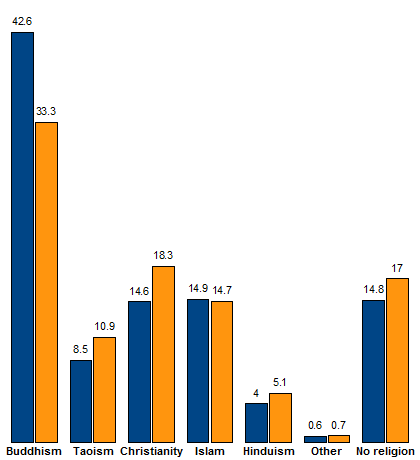
The 2010 Population Census of Singapore has just been released. The following is a graph representing the change in religious affiliation over the past decade. Blue represents the percentage of the population in 2000 and orange for 2010.


From the data, it is clear that all religious categories increased in proportion over the decade with the sole exception of Buddhism. Amongst those experiencing an increase, Christianity, Taoism, Hinduism and people who identify with "no religion" show significant growth. Islam and "other religions" remained relatively stable.

Figures tell that the younger generations are more likely to profess "no religion". The non-religious has seen an increase in proportion across alll age groups. Almost one in four university graduates had no religion - although this figure has fallen from 28.9% (2000) to 24.2% (2010).

The ethnicity of the non-religious seems to be almost completely Chinese, accounting for about 97% of those who profess "no religion". This number account for slightly more than one-fifth of the Chinese population.


Although 17% of Singaporeans identify with "no religion", it is not clear what fraction have reached the position because of skepticism. But in general, it is somewhat promising to see some increase in irreligiosity.

Singapore Census of Population 2010
There are no direct links to/quotes of the document in question due to copyright. The data represented here have been drawn from newspaper publications (The Straits Times, 13 Jan 2011) which presumably have been granted permission to publish these results.

While no direct links are allowed, you may visit SingStats by searching "statistics singapore" on Google. At the site, go to Publications", look for the document in question under "Singapore Census of Population 2010".

Religious harmony, really?

Recently, in the newspapers, there have been a couple of praise or mention of religious harmony in Singapore. One letter in the forum section of the Straits Times even commented that "The Prime News photograph yesterday (above) of Rabbi Mordechai Abergel, Buddhist monk the Venerable Fa Rong and Mufti Syed Isa Mohamed Semait nearly moved me to tears." (The Straits Times - ST Forum - Picture perfect harmony)


It's good so far
Before I continue, I need to say that I do like the fact that Singapore enjoys religious harmony. Religions do not make much issue here unlike some of our neighbours (such as Christianity vs Islam in Indonesia).

To be clear, I am all for religious harmony.

Now here comes the big "but",
But, I don't think that that is a solution in the long run.


Exclusivity of religious truth
Religions make truth claims. Unless the religion advocates the kind of universalism where it teaches that all religions are different paths to god(s), religions are mutually exclusive. No two religion can be simultaneously correct.

Look at Old Testament (Christianity) or Tanakh (Judaism) on the issue of other gods

From the Book of Deuteronomy (Tanakh/Bible)

Deuteronomy 17:2-7 (New International Version, NIV)
If a man or woman living among you in one of the towns the LORD gives you is found doing evil in the eyes of the LORD your God in violation of his covenant, and contrary to my command has worshiped other gods, bowing down to them or to the sun or the moon or the stars in the sky, and this has been brought to your attention, then you must investigate it thoroughly. If it is true and it has been proved that this detestable thing has been done in Israel, take the man or woman who has done this evil deed to your city gate and stone that person to death. On the testimony of two or three witnesses a person is to be put to death, but no one is to be put to death on the testimony of only one witness. The hands of the witnesses must be the first in putting that person to death, and then the hands of all the people. You must purge the evil from among you.


What about the Koran's (Islam's) view of Christianity,

From the Qur'an, the holy book of Islam

Qur'an 5:72-78 (Yusufali translation)
They do blaspheme who say: "Allah is Christ the son of Mary." But said Christ: "O Children of Israel! worship Allah, my Lord and your Lord." Whoever joins other gods with Allah,- Allah will forbid him the garden, and the Fire will be his abode. There will for the wrong-doers be no one to help. They do blaspheme who say: Allah is one of three in a Trinity: for there is no god except One Allah. If they desist not from their word (of blasphemy), verily a grievous penalty will befall the blasphemers among them.

Why turn they not to Allah, and seek His forgiveness? For Allah is Oft-forgiving, Most Merciful.

Christ the son of Mary was no more than a messenger; many were the messengers that passed away before him. His mother was a woman of truth. They had both to eat their (daily) food. See how Allah doth make His signs clear to them; yet see in what ways they are deluded away from the truth!

Say: "Will ye worship, besides Allah, something which hath no power either to harm or benefit you? But Allah,- He it is that heareth and knoweth all things." Say: "O people of the Book! exceed not in your religion the bounds (of what is proper), trespassing beyond the truth, nor follow the vain desires of people who went wrong in times gone by,- who misled many, and strayed (themselves) from the even way.
Curses were pronounced on those among the Children of Israel who rejected Faith, by the tongue of David and of Jesus the son of Mary: because they disobeyed and persisted in excesses.

I think I need not say more about the exclusivity of the truth claims of the fore mentioned religions.

Even without these intolerant ideas in their holy books, religions feeds off human tribalism. It fosters divisiveness explicitly or implicitly, creating a Us versus Them situation whenever it is deemed fit.


The inherent danger of reversion
Yes, I understand believers have various reasons to ignore or not act on behalf of their holy books. But the fact remains that those verses are in their holy books. A simple reversion to fundamentalism or literalism will unleash yet more evils of religion upon the society.

Religious fervor transcend educational and economic boundaries (and indeed, national ones). This is notably true in present day events. The perpetrators of the 9/11 attacks were educated Muslims from middle income families from different countries. There was the assassinations of abortion-providing doctors in the United States of America. Religion is clearly capable of inspiring insane atrocities.


Really harmony?
Is this harmony (in Singapore) we see truly what it seems?
Can it survive the religious fanaticism emanating from the rest of the globe?

Are the religions in Singapore really holding hands and skipping across the beautiful meadows of peace?

Or is it just begrudging tolerance - with religions sitting around a table with weapons behind them waiting for someone to say or do the wrong thing?

I am simply saying that we need to recognize this issue and actually address it. This fluffed up image of harmony fails to address this inherent danger of religions.

Peace does not come about by ignoring clear and present danger.

Layman Public

This was originally written as a response to letter published in the New Paper (24 March). However, I never got around to write it down proper.

Instead of doing that, I decided to just pick out a few bits and post them in this blog entry. (And yes, I do realized that's like 2 months ago - things happened).

The church has said that the claims of faith healing were based on actual testimonies by those who have had such first hand experiences. These claims should be demonstrably verifiable.

Yes, indeed, such reports should be demonstrably verifiable.

However, take note, the real issue is with demonstrating what the claims in the testimonies. And that must be done via clinical trials (since we are talking about "medicine"). The testimonies themselves are not worth much at all - for the make one of the lousier forms of evidence.

Anecdotes about subjective experience is necessarily second hand information to any objective observer. They are known to be wrought with psychological and perceptual errors such as confirmation biases, false memories and other illusions. Given such knowledge, scientists tend to treat anecdotes as starting points for further research - the anecdote itself is close to being worthless without other supporting objective data.

...... if there are people who can testify that they were healed through such prayers and prove their case with medical research?

As mentioned previously, personal testimonies are not worth much as evidence - such data is clouded by a myriad of human errors.

In medical cases, a layman may (and many times will) interpret the well-known placebo effect as the efficacy of the alternative medicine he is observing. That is just one reason - other phenomenons prevent uncritical individuals from knowing fact from fiction thus rendering such testimonies useless.

In any case, if we're talking about healing through prayer, I dare bet that the medical records will show that is as effective as chance (or at best, the placebo effect). On a side note, I want to add that taking aspirin while praying your headache away is not a demonstration of the efficacy of prayer.

I would like to add in the matters of faith, science is not reliable measure. Science cannot make pronouncements one way or the other on God,

False.

Science is, in principle, capable of examining the question of god(s)' existence. The existence of any entity that we can meaningfully say to exist should be detectable and measurable - God or gods is no exception.

* Why "meaningfully say to exist"?, check out On Existence.

If your god, or any gods, exist in actual physical reality, he would be detectable. Similarly, if your god, or any gods, is capable of manifesting and interacting with the natural world, he would be detectable even if he is "supernatural".

... metaphysics,

False too.

Metaphysics, ie the study of the nature of reality, should at least partially informed by science. As long we're still talking about our observable reality, I seriously doubt metaphysics belongs to the list.

... ethics...

Why is ethics even on the list? Why do some religious still think in such a manner?

Science is a method of acquiring knowledge, NOT a system of ethics. Science comes closest with ethics as an informant but the method itself is amoral.

Scientists being ethical and unethical is a separate issue and has no bearing on the methodology itself.

... and so on and it certainly cannot declare them meaningless.

Who did that anyways? (If you followed the letters yourself, you might ask the same question)

Science does not make such value judgments. But if your belief involve actual physical reality, then science most definitely can inform your of its validity.

...... The claims could "mislead the public" because they "do not operate under scientific boundaries".

I disagree with the usage of the phrase "do not operate under scientific boundaries" in the context.

Nature does not operate under scientific laws. Rather scientific laws are our attempts to describe how nature operates. Unlike our legal laws, scientific laws are descriptive not prescriptive. We follow legal laws; Scientific laws describe the workings of nature. There's a difference - understand the logic.

The relevant, more appropriate, phrase may be "have not been sufficiently verified" or "yet to be demonstrated beyond reasonable doubt". When phrased this way, it exposes the emptiness of the tired arguments against the idea that things "operate under scientific boundaries".

Faith healing cannot be quantified by science.

Utterly wrong.

If faith healing actually works (ie, cures illnesses), its effects would be quantifiable. This would show up as statistical significance on clinical trials. This is true regardless whether its mechanisms is known or unknown ("supernatural" or not).

... (science) which itself changes over time with each new scientific discovery.

Hmmm, why is this always phrased with the implicit idea that it's a bad thing?

It's the beauty of science that it is self-correcting in nature.

Which is worst? Changing and inching towards a more accurate picture of reality or stay wrong forever and not know it as with religious dogma.

I'll take science over religion (or any dogma) any and everyday.